A red brick single-story house with a covered porch and adjacent cream-sided houses behind a trimmed hedge and lawn, framed by large oak trees draped with Spanish moss under an overcast sky.

AC Installation in Spartanburg, SC

Tell us about the job

Takes about a minute. No obligation.

New system or replacementCentral ACSpartanburg County, SC
Step 1 of 2

What ZIP code is the job in?

The size has to match the house

An AC unit that's too big cools the air fast and shuts off before it pulls the moisture out, so rooms feel clammy even at the right temperature. One that's too small runs constantly and never quite catches up on the hottest days. Getting the size right takes a room by room look at the house, not just a guess based on the old unit.


The ductwork decides more than the unit does

A new system pushes air through the ducts that are already in the house. If they're too narrow, leaky, or routed poorly, even a well matched unit struggles to deliver air where it's needed. Sealing or modifying ductwork adds work beyond setting the new unit in place, but skipping it leaves rooms that never cool evenly.

5 months
May through September, your air conditioner is on duty
88°F
the average summer afternoon it cools against
53 hail events
in ten years, and hail bends the fins on outdoor coils
13.4 SEER2
the federal minimum any new unit must meet
Isometric cutaway illustration of a single-story house showing interior rooms, ceiling ductwork, an indoor air handler, and an outdoor condenser unit connected by lines, in gray and white tones on a white background.
Your air conditioner works hardest from June through August.

NOAA nClimDiv, 1991–2020 normals

Cooling runs May through September in Spartanburg County.

April is when a new system should already be installed, not when you start calling around.

Most homes here run on electricity, and that's what central AC installs alongside

67.7% of homes heat with electricity
Cooling runs May through September
Summer afternoons average 88°F

Electricity here runs 14.23 cents per kilowatthour. That's the rate every hour of cooling gets charged against. A system that's lost some efficiency, or was sized wrong for the house, pulls more power to hold the same temperature, and that extra power costs the same 14.23 cents as the rest. Installed right, with the ductwork sealed and the unit matched to the house, a system does the job on less power. That difference shows up on the bill as long as the AC is running.

Spartanburg's minimum is 14.3 SEER2, not the national 13.4

Any new system installed here now has to hit 14.3 SEER2, the regional minimum for the Southeast and a step above what the rest of the country requires. That rules out some lower-end units you might find listed online or at a box store. It also qualifies for the federal tax credit on qualifying equipment, which can offset part of the cost. A contractor installing to code here already knows which units clear the bar.

Find a contractor
An outdoor air conditioning condenser unit mounted on a concrete pad beside a house, with electrical conduit running to a wall-mounted disconnect box.

A summer of running is a summer of wear, and sizing decides how much

A unit sized right runs long, steady cycles and wears evenly over the summer. One that's oversized short cycles instead, cooling the air fast and shutting off before it finishes pulling the moisture out of the house. Every start draws a hard hit of current and puts the most strain on the compressor and the contactor, so a system that cycles on and off all day is stopping and starting far more than it should over the summer. An undersized unit has the opposite problem. It runs nearly nonstop on the hottest afternoons, trying to catch up and never quite getting there, piling up hours on the compressor without the rest a right sized system gets overnight. Either mistake shortens the life of the equipment. The sizing itself comes from a room by room load calculation, not the tonnage of the unit being replaced. Square footage, window placement, insulation, and how the house is used all factor in, because houses that look alike from the outside can need different sized systems entirely.

The old unit gets disconnected and hauled off

Refrigerant gets recovered from the old system before any line is cut. It's against the law to vent it into the air, so a contractor pulls it into a tank with a recovery machine first. After that the old unit, the pad or cradle it sat on, and any line set being replaced all get hauled away as part of the job.

What's left behind depends on what's being reused

If the line set and pad are in good shape and match the new unit, a contractor may leave them in place rather than replace them. Anything from the old system that's corroded, undersized, or carrying the wrong refrigerant for the new unit gets pulled out, since running a new system through old parts built for a different unit causes problems down the line.

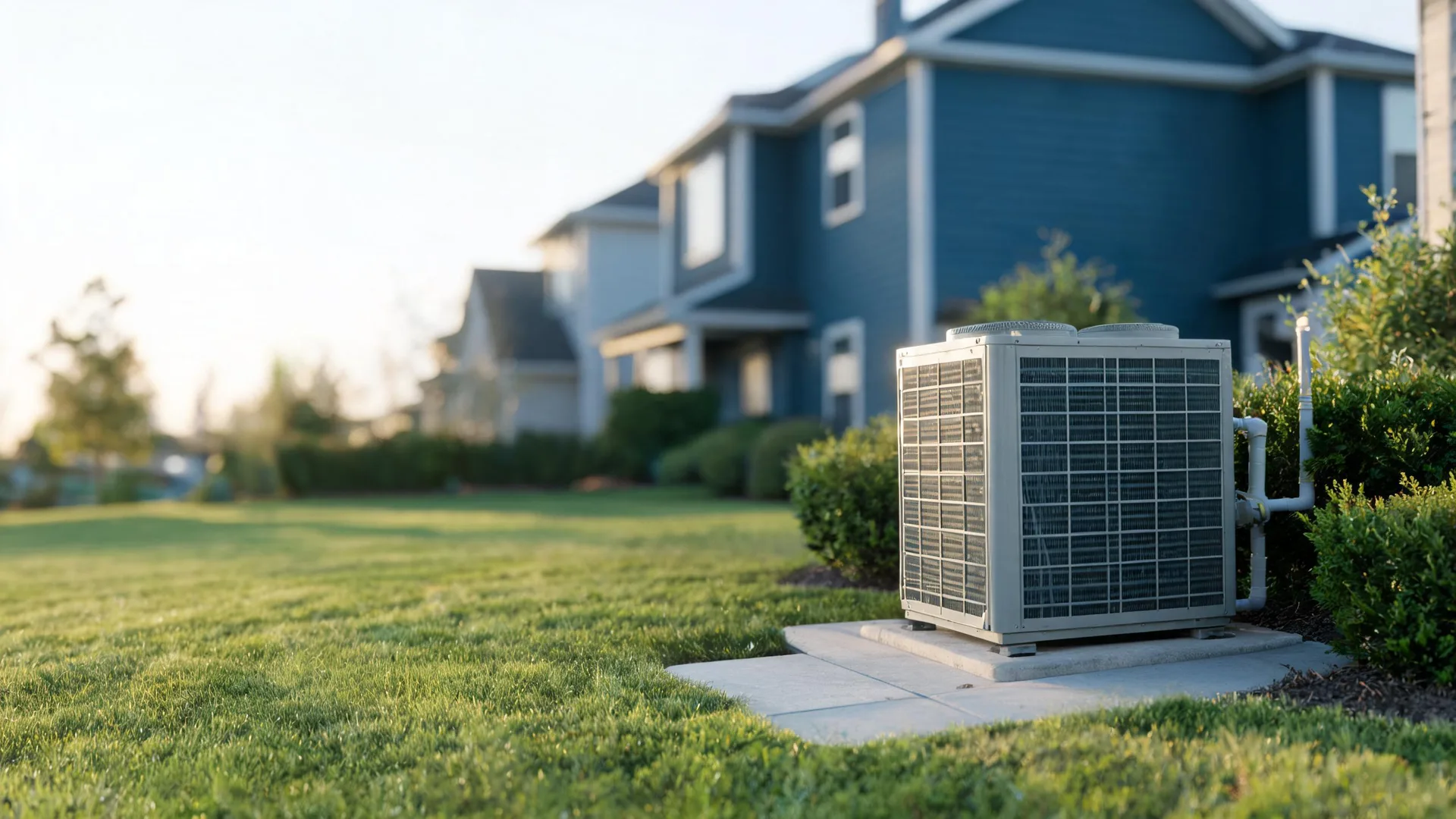
An outdoor air conditioning condenser unit mounted on a concrete pad next to a blue-sided residential house at sunset.

Going above the federal minimum saves little here, about $20 a year.

  • A higher-efficiency unit$300 a year
  • A new unit at the federal minimum, 14.3 SEER2$320 a year

Estimates for a typical Spartanburg County home, from EIA household energy data, South Carolina fuel prices and NOAA climate normals. Your home will differ.

Installation day starts with the power off and the old system fully disconnected before any new part goes in. The indoor coil and outdoor unit get set in place, and the line set gets connected or run new. Every joint gets brazed, then pressure tested before any refrigerant goes near it. A tech pulls a vacuum on the line set to clear out air and moisture, since either one left behind corrodes the system from the inside and ruins the charge. Once the vacuum holds, refrigerant gets weighed in to the amount the manufacturer specifies for that unit and that length of line. Then the system runs through its paces. Airflow gets checked at the vents, the temperature split between the air going in and the air coming out gets measured, and the thermostat gets tested to make sure it's actually talking to the equipment. Nothing gets called finished until it's been watched running a full cycle.