Aerial view of a gray outdoor air conditioning condenser unit mounted on a concrete pad next to a house with vinyl siding.

AC Maintenance in Gaffney, SC

Tell us about the job

Takes about a minute. No obligation.

Tune-up, service, or cleaningCentral ACCherokee County, SC
Step 1 of 2

What ZIP code is the job in?

Change the filter yourself

A dirty filter chokes airflow across the coil, and that makes the whole system work harder to do less. Pull it, hold it up to the light, and if you can't see through it, swap it. This is the one thing an owner can do that actually prevents a service call.

Leave the rest to a contractor

Checking refrigerant charge, testing the capacitor, clearing the condensate drain, none of that is safe or useful to do yourself. Opening the cabinet without the right gauges can hurt the system or you. Keep the area around the outdoor unit clear of leaves and grass clippings, and let a licensed contractor handle what's inside it.

5 months
May through September, your air conditioner is on duty
88°F
the average summer afternoon it cools against
18 hail events
in ten years, and hail bends the fins on outdoor coils
49 wind events
in ten years, and wind drives debris into outdoor units
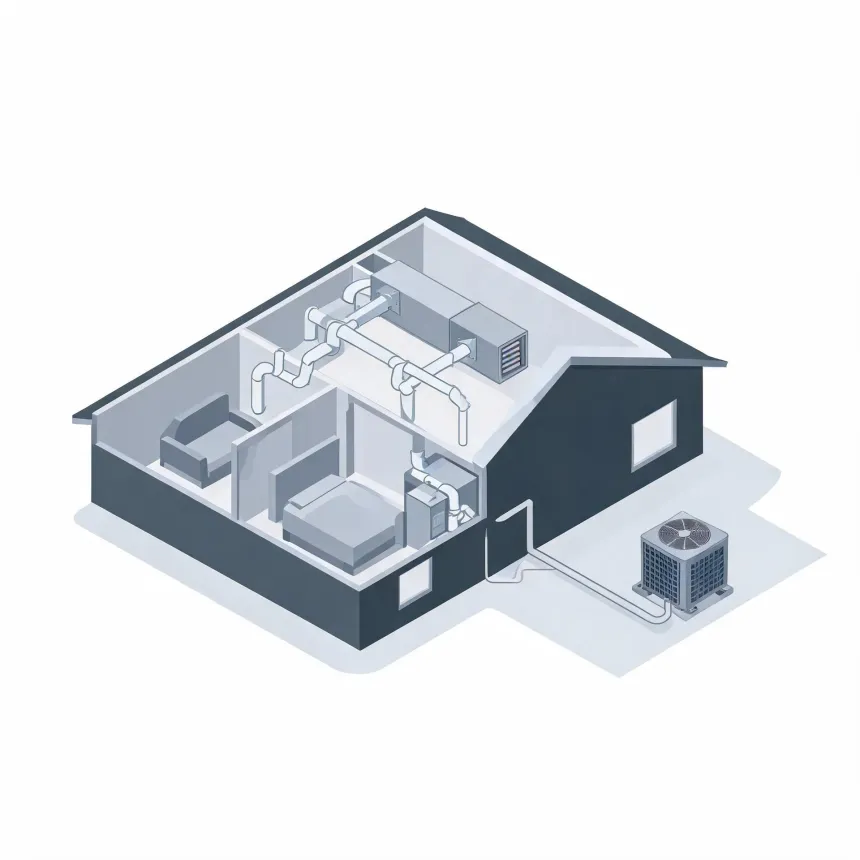
Isometric cutaway illustration of a house showing interior ductwork, an air handler and furnace unit, and an outdoor condenser connected by lines outside the wall.
Your air conditioner works hardest from June through August.

NOAA nClimDiv, 1991–2020 normals

Cooling in Gaffney starts in May and runs through September.

April is the month to get the AC checked, right before it has to carry the heat.

One tune-up a year covers a system built to run May through September

Half the homes here were built by 1984
Cooling runs May through September
Summer afternoons average 88°F
Five months of summer, one visit to get readyAfternoon highs average 88°F across June, July and August here.

A dirty coil or a weak capacitor makes the compressor work harder to move the same heat out of the house. That extra work shows up on the electric bill. South Carolina homes paid 14.23 cents per kilowatt-hour in 2024, and that rate applies whether the system is running clean or straining. A tune-up catches the coil that needs cleaning or the charge that's run low, before a summer of cooling runs up a bigger bill than it should.

Book it before the season

It starts running hard in the first month of the season here. Book the check the month before.

Find a contractor
A gray cylindrical air conditioning condenser unit mounted on a concrete pad next to a light-colored vinyl-sided house exterior.

The filter, the coil and the drain all depend on each other

Air gets pulled through the filter, across the evaporator coil, and out through the ducts every time the system runs. A clogged filter starves that airflow, and the coil behind it can't shed heat the way it's built to. Moisture that's supposed to condense on the coil and drip into the drain pan starts collecting unevenly, and a coil that stays wet and dirty grows mold while it loses capacity. The condensate drain just carries water away, until algae clogs it and the pan backs up, and then water goes where it shouldn't. None of these parts fail alone. A clogged filter stresses the coil, a dirty coil holds more moisture, and that moisture feeds the clog in the drain line. Catching one early is what keeps the others from turning into a problem.

The compressor wears out faster

A compressor that runs dirty or low on refrigerant works harder every time it cycles on. That strain adds up over seasons, and a compressor that burns out early is usually the last part to go after smaller problems ran unchecked for years.

Small problems don't stay small

A capacitor that's starting to weaken still starts the system, just slower, so nobody notices. A coil that's picking up dust still cools, just a little less. Left alone, the weak capacitor eventually fails outright, usually on the day the system is working hardest.

Aerial view of a gray central air conditioning condenser unit on a concrete pad next to a house with vinyl siding.

Book your AC tune-up in April, before homes here start needing cooling in May.

  1. Jan
  2. Feb
  3. Mar
  4. Apr
  5. May
  6. Jun
  7. Jul
  8. Aug
  9. Sep
  10. Oct
  11. Nov
  12. Dec

A tune-up checks the refrigerant charge, cleans the coils, tests the capacitor and tightens the electrical connections.

A proper tune-up starts with the refrigerant charge, checked against what the system calls for, since too little or too much makes the compressor work harder for the same cooling. The contractor tests the capacitor and contactor, the parts that get the compressor and fan started and keep them running, because a weak capacitor is a near-term failure, not a maybe. The evaporator coil and condenser coil both get inspected, and cleaned if they're holding dust or grime, since a dirty coil can't shed heat the way it's supposed to. The condensate drain gets cleared so water has somewhere to go. Electrical connections get checked for corrosion, and the blower gets looked at too, since it's the part moving air across that coil in the first place.