A red brick single-story house with a covered porch and adjacent cream-sided houses behind a trimmed hedge and lawn, framed by large oak trees draped with Spanish moss under an overcast sky.

AC Installation in Columbia, SC

Tell us about the job

Takes about a minute. No obligation.

New system or replacementCentral ACRichland County, SC
Step 1 of 2

What ZIP code is the job in?

The Southeast minimum is higher here

Columbia falls under the Southeast's regional rule, not just the national one. A split system under 45,000 Btu/h, the size most houses use, has to hit at least 14.3 SEER2. A unit built only to the national floor won't clear that.

That narrows what a contractor can offer you

Richland County's long, humid summers run on this higher standard, so any central air conditioner installed here has to be rated for it. If you're comparing quotes, ask whether the SEER2 rating on each unit actually clears the regional minimum, not just the national one.

5 months
May through September, your air conditioner is on duty
91°F
the average summer afternoon it cools against
49 hail events
in ten years, and hail bends the fins on outdoor coils
13.4 SEER2
the federal minimum any new unit must meet
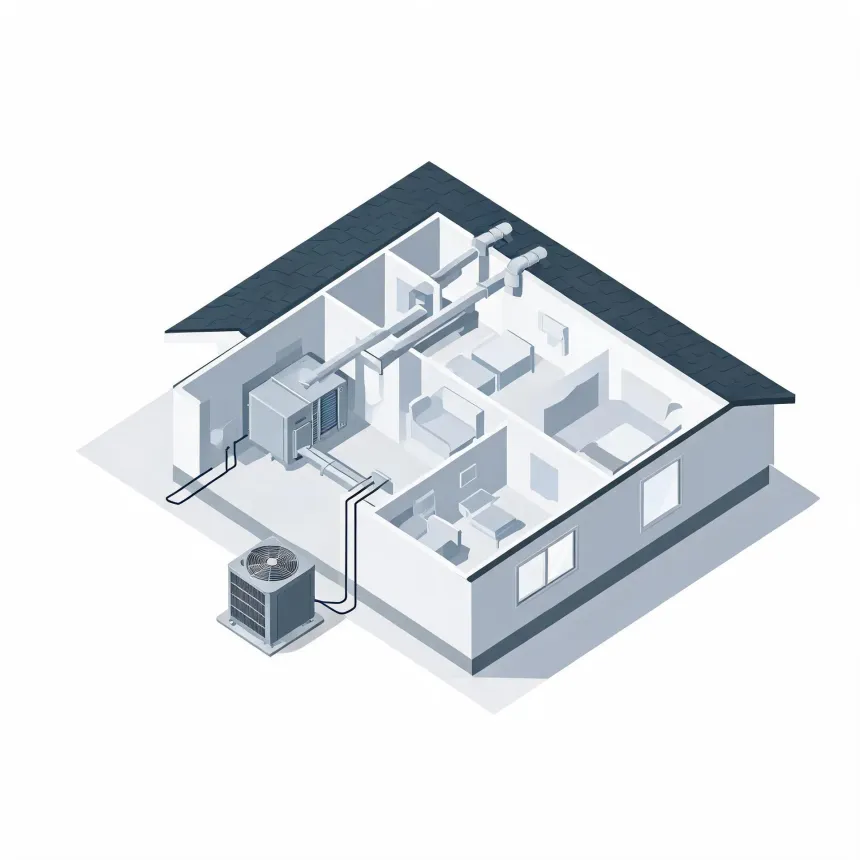
Isometric cutaway illustration of a single-story house showing interior rooms, ceiling ductwork, an indoor air handler, and an outdoor condenser unit connected by lines, in gray and white tones on a white background.
Your air conditioner works hardest from June through September.

NOAA nClimDiv, 1991–2020 normals

Electricity heats 73.4% of homes in Richland County, gas 23.3%.

If your house already runs on electric heat, an electric heat pump or straight AC with electric furnace backup is the straightforward swap.

Put it in before May, while it's on your schedule

Cooling runs May through September
Summer afternoons average 91°F
360 damaging wind events from 2015 to 2024

Richland County runs its air conditioner May through September. June through August the afternoon high averages 91°F, and the system has to answer for it almost every day that whole stretch. A unit sized even a little wrong pays for that over five months straight. Too small and it never catches up on the hottest afternoons. Too big and it short cycles instead of actually pulling the humidity down. The outdoor unit also sits through whatever the weather brings, and this county sees its share of damaging wind and hail. Get the sizing right and buy a unit built for the work, not just the lowest number on the quote.

Power costs more here, so efficiency pays you back

South Carolina homes paid 14.23 cents per kilowatthour for electricity in 2024, more than most states pay. A new system here runs for months on end, so every point of efficiency on the rating sticker shows up on the bill. Pick a unit built to actually clear the standard for this region, not just meet it.

Find a contractor
A gray metal air conditioning condenser unit mounted on a concrete pad in a flat grassy field under a partly cloudy sky.

The number on the sticker is a ratio, not a size

The SEER2 number on the label is a ratio, cooling output over the electricity it takes to produce it. A higher number means the compressor and the coil are moving the same heat for less power draw. It isn't a measure of how strong the unit is or how fast it cools a room. A high-rated system and a low-rated one can be sized exactly the same and still pull very different amounts of power to do that job, and that gap holds every time the compressor kicks on. Run that all summer and it stops being a number on a sticker and starts being how the system actually runs in your house.

Ask what the load calculation found

A contractor should size your system by measuring your house, not by matching the one that's already out there. That means checking window area, insulation, and square footage room by room. A quote with a number on it but no explanation of how they got there is a guess, not a calculation.

Ask what happens to the ductwork

A new system only moves as much air as the ducts let it. If the ducts were sized for a different unit or have leaks or crushed runs, the new system can be sized right and still cool unevenly. Ask whether the ducts were inspected and whether they need any work before the new unit goes in.

Aerial view of a gray outdoor air conditioning condenser unit mounted on a concrete pad next to a house with vinyl siding.

A higher-efficiency unit would save about $30 a year to run in Richland County compared with a new unit at the federal minimum.

  • A higher-efficiency unit$380 a year
  • A new unit at the federal minimum, 14.3 SEER2$410 a year

Estimates for a typical Richland County home, from EIA household energy data, South Carolina fuel prices and NOAA climate normals. Your home will differ.

Installation day starts with the old system coming out, indoor and outdoor units both, along with the old refrigerant line set if it's not being reused. The new outdoor unit gets set on a pad or a stand, leveled, because a unit sitting crooked wears its compressor unevenly over time. Indoors, the coil goes in above or beside the furnace or air handler, and that's where a lot of the real work happens, fitting it tight to the existing ductwork so air isn't leaking out around it. New refrigerant lines get run, the system gets evacuated to pull all the moisture and air out of those lines, then it's charged to the exact weight the manufacturer specifies, not just topped off by feel. Once it's running, a tech checks the charge against the temperature split at the vents and tests the thermostat and any safety switches before calling it done. A clean install also means sealing and insulating the refrigerant lines where they pass outside, since bare copper sweats and wastes energy. None of that shows up on the invoice, but it's the difference between a system that runs the way the rating sticker says it should and one that just runs.