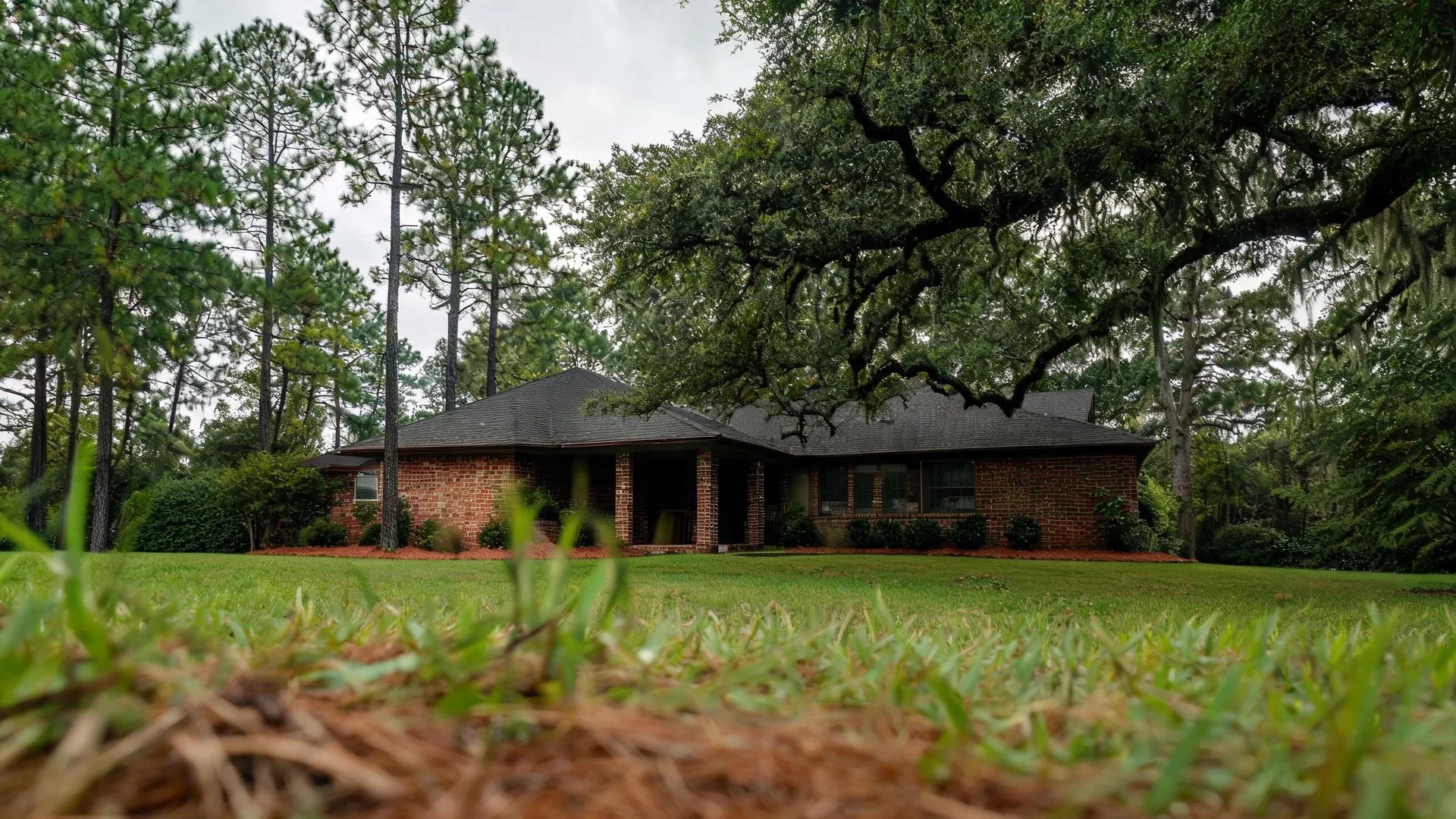
A single-story brick house with a dark shingled roof set behind a lawn, framed by pine trees and a large spreading oak, photographed from a low angle with blurred grass in the foreground.

AC Installation in Winnsboro, SC

Tell us about the job

Takes about a minute. No obligation.

New system or replacementCentral ACFairfield County, SC
Step 1 of 2

What ZIP code is the job in?

Most homes here run on electricity

Electricity heats 68.3% of occupied homes in Fairfield County. Gas, either utility or bottled, is under the other quarter combined. A new AC system here is almost always paired with electric heat already, not a gas furnace.


That makes a heat pump worth asking about

When the home already runs on electricity, a heat pump can cover both the cooling job and the heating job through one outdoor unit. Worth bringing up during an installation quote, especially with power cuts a real concern here.

5 months
May through September, your air conditioner is on duty
90°F
the average summer afternoon it cools against
21 hail events
in ten years, and hail bends the fins on outdoor coils
13.4 SEER2
the federal minimum any new unit must meet
Isometric illustration of a cutaway single-story house showing attic ductwork, an indoor air handler, interior rooms with furniture, and an outdoor condenser unit connected by lines, on a white background.
Your air conditioner works hardest from June through September.

NOAA nClimDiv, 1991–2020 normals

Fairfield County homes split evenly between built before 1984 and after.

Standard sizing and a standard efficiency unit fit either one, no special equipment needed.

At 14.23 cents a kWh, every point of efficiency shows up on the bill

Power costs 14.23 cents a kWh statewide
Cooling runs May through September
Summer afternoons average 90°F

Fairfield County is warm most of the year, with a short mild winter. Systems installed here have to clear a higher bar than the national minimum. A new split-system AC under 45,000 Btu/h only has to hit 13.4 SEER2 to be sold anywhere in the country. Here in the Southeast, that same size unit has to hit 14.3 SEER2. A contractor quoting a system in Fairfield County should already be working from that regional number, not the national one. A federal tax credit is also available for qualifying high-efficiency equipment, worth asking about when comparing quotes.

Have AC installed before May, not after

Cooling here runs May through September. If the current system is on its way out, getting the new one in during April means it's working before the first hot day, not after one.

Find a contractor
A man in a cap, dark jacket and olive pants climbs porch steps toward a green front door, carrying a canvas tool bag filled with hand tools, with a potted shrub to the right.
An outdoor residential air conditioning condenser unit mounted on a concrete pad, surrounded by gravel with a blue sky in the background.

The label is a seasonal average, not one afternoon's performance

The SEER2 number on the label is a seasonal average, not what the unit does on any one afternoon. It's measured over a full season of running, cycling on and off as the load changes rather than holding flat out the whole time. Where the cooling months are short and mild, a system barely gets asked to prove that number. Where they stretch long, the compressor and outdoor fan rack up real hours proving it, season after season. A higher SEER2 unit is built to carry those hours without its power draw climbing right along with them. The rating also assumes the system is charged correctly and getting full airflow across the coil. Installed low on refrigerant or starved for return air, a unit runs below its rated number no matter what the label says, and the compressor works harder every month to make up the difference.

Ask for the load calculation, not just a quote

A contractor should size the system from a room by room load calculation, checking window area, insulation and layout, not just matching the tonnage of whatever is already installed. A unit sized off the old system can carry over a sizing mistake nobody caught the first time.

Ask what happens to the ductwork

A new outdoor unit moving more or less air than the old one needs ducts that can actually carry that airflow. If nobody checks the duct sizing and the return air path, the new system can end up fighting the same duct problems the old one quietly had.

Overhead view of an air conditioning condenser unit on a concrete pad next to a house with asphalt shingle roofing and vinyl siding.

Going above the federal minimum saves little here, about $20 a year.

  • A higher-efficiency unit$350 a year
  • A new unit at the federal minimum, 14.3 SEER2$370 a year

Estimates for a typical Fairfield County home, from EIA household energy data, South Carolina fuel prices and NOAA climate normals. Your home will differ.

Installation day starts with the old equipment coming out, not the new one going in. The outdoor unit, the indoor coil, and often the line set all get disconnected and hauled off before anything new gets set in place. A contractor will usually check the line set and decide whether it gets reused or replaced, since the refrigerant running through a new system often isn't compatible with what the old one used. Once the new outdoor unit is set and the coil is in, the system gets charged with refrigerant, wired in, and tested under a running load, not just switched on and left. That test run is when a contractor checks airflow at the vents and confirms the system is actually cooling, not just powering on. Expect the power to be off for part of the day while the electrical connections are made and checked.