An outdoor air conditioning condenser unit positioned on a concrete pad next to a blue-sided house, surrounded by green shrubs and flowering hydrangeas at sunset.

AC Repair in Barnwell, SC

Tell us about the job

Takes about a minute. No obligation.

RepairCentral ACBarnwell County, SC
Step 1 of 2

What ZIP code is the job in?

The tech checks before touching anything

A diagnostic starts with the thermostat setting, the breaker, and the condensate line before the panels ever come off. A tripped float switch or a blown fuse can look like a dead system when the fix is that simple. Only after those are ruled out does the tech open up the unit to check the capacitor, the contactor, and the refrigerant charge.

What the visit tells your contractor

Pressures, temperatures, and amp draw on the compressor and fan motor point to a specific failing part rather than a guess. That reading decides whether the job is a worn capacitor, a leak in the coil, or a compressor on its way out, and whether the unit is worth repairing at all.

5 months
May through September, your air conditioner is on duty
91°F
the average summer afternoon it cools against
3 hail events
in ten years, and hail bends the fins on outdoor coils
53 wind events
in ten years, and wind drives debris into outdoor units
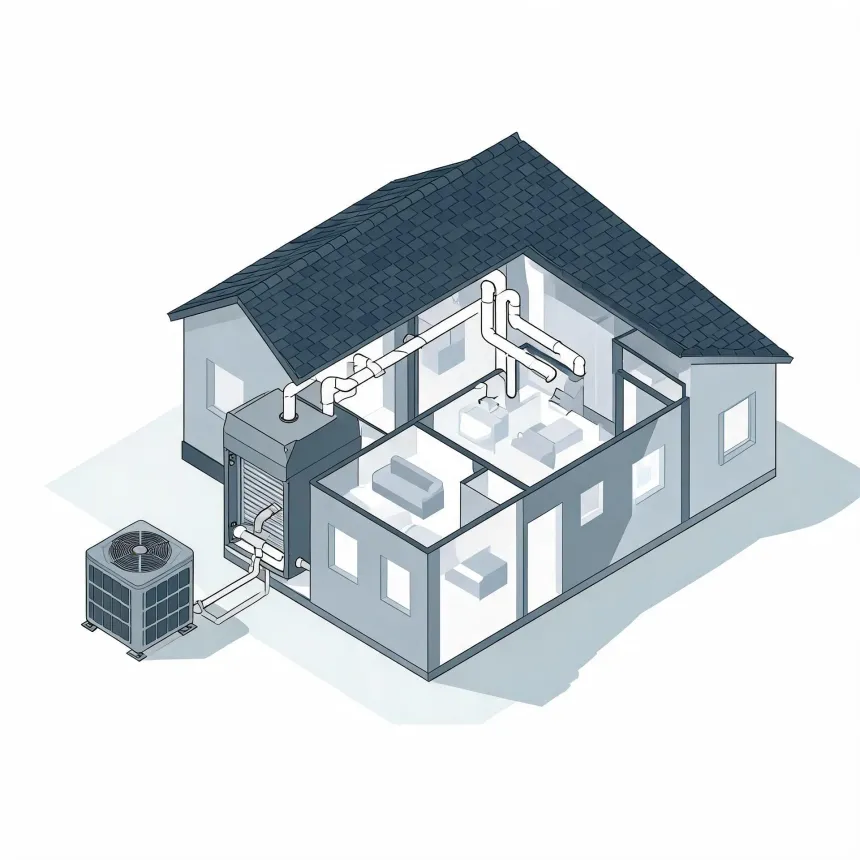
Isometric illustration of a cutaway single-story house showing interior rooms, ductwork running from an indoor air handler, and an outdoor condenser unit on a pad beside the building.
Your air conditioner works hardest from June through September.

NOAA nClimDiv, 1991–2020 normals

Barnwell County cools for five months straight, May through September.

Afternoon highs average 91 through June, July and August, and the compressor runs through all of it. That's usually where a repair call starts.

At 14.23 cents a kWh, a struggling AC runs up the bill every month it's running

Power costs 14.23 cents a kWh statewide
Cooling runs May through September
Summer afternoons average 91°F

Half the homes in Barnwell County were built in 1983 or earlier, half in 1983 or later, and that split does not tell you much about the unit outside. Most AC systems get replaced at least once over a house that age, so what matters is when this one went in, not when the house did. Mobile homes make up close to a third of the housing stock here. A condenser and air handler work the same way whether the home sits on a slab or on blocks. What fails is what fails anywhere. A capacitor weakens. A contactor pits. A slow leak drops the charge low enough that the compressor can't keep up. There's no local quirk driving the call, just a compressor that's been carrying the load for months and is due for the usual wear.

The weak part shows up early in the season

May is when cooling starts here, and the first hot stretch is when a weak part finally gives out. If your AC made it through last September but is struggling now, get it looked at before the season puts a real load on it.

Find a contractor
A man in a cap, dark shirt and tan work pants, seen from behind, carries a worn duffel bag as he climbs steps toward a dark green front door beside a potted shrub.
An outdoor air conditioning condenser unit mounted on a concrete pad surrounded by gravel, photographed against a partly cloudy blue sky.

Months of heat add up to wear

Five months of running time and afternoon highs near 91 add up to a lot of hours on the compressor. If yours is already struggling, that's wear talking, not a mystery. Get it diagnosed now rather than waiting to see if it holds. A tech can check the charge and the amp draw and tell you whether this is a part worth replacing or a compressor nearing the end of its run.

What you'll notice first

Warm air out of the vents, the system running longer than it used to, or it short cycling on and off every few minutes. Sometimes it's a smell when it kicks on, or a hiss or click from the outdoor unit that wasn't there before. Water pooling near the indoor unit means the condensate line is clogged or the drain pan has cracked.

What those signs are worth

None of them tell you the part on their own, but they tell you whether to wait. Warm air and short cycling can mean the charge is low or a capacitor is failing, and both get worse the longer the compressor runs on them. A clicking contactor usually still works until the day it doesn't. Water on the floor won't wait, since it points to a blocked line that can back up and trip a float switch, shutting the whole system down.

Overhead view of an outdoor AC condenser unit on a concrete pad next to a house with a dark shingle roof.

A new air conditioner would cut about $70 a year off cooling for a typical Barnwell County home.

  • A new one at the federal minimum, 14.3 SEER2$410 a year
  • An older air conditioner$480 a year

Estimates for a typical Barnwell County home, compared with an older unit built to the previous federal minimum, from EIA household energy data, South Carolina fuel prices and NOAA climate normals. Your home will differ.

Repair makes sense when a part like a capacitor or contactor has failed.

Replacement makes sense when the compressor has failed or the system uses R-22 refrigerant, which is no longer made.

A repair is worth doing when one part has failed and the rest of the system is still carrying its load fine. A new capacitor or contactor is a small fix on a compressor that still has years in it. Replacement starts to make sense when the compressor itself is the problem, since that part isn't sold on its own and swapping it costs most of what a new system would. Age matters too, but not by itself. A unit that's needed a repair every season is telling you something a single breakdown isn't. If the coil is leaking refrigerant, ask whether it's a patchable spot or a coil that's corroding in more than one place, because that changes which side of the repair-or-replace line it falls on. A tech checking the charge and the amp draw can usually tell you which kind of problem you've got before any parts get ordered.