





A red brick wall with a row of low shrubs and mulch bed on the left, a mown lawn in the center, and a single-story light-colored house with a gabled roof beyond, backed by pine trees under an overcast sky.

AC Repair in Lexington, SC

Tell us about the job

Takes about a minute. No obligation.

RepairCentral ACLexington County, SC
Step 1 of 2

What ZIP code is the job in?

Lexington County logged 434 severe weather events between 2015 and 2024, and wind did most of that damage. Hail dents a condenser cabinet and bends the fins on the coil inside it. Wind-blown debris does the same, or worse, if a branch catches the fan blade. None of that stops your AC from running the day it happens. The damage shows up weeks later as a system that runs longer or quits on the next hot afternoon. If your outdoor unit took a hit this year, it's worth having someone look it over even if it still blows cold.

5 months
May through September, your air conditioner is on duty
91°F
the average summer afternoon it cools against
74 hail events
in ten years, and hail bends the fins on outdoor coils
325 wind events
in ten years, and wind drives debris into outdoor units
Isometric cutaway illustration of a single-story house showing interior rooms, ductwork and an air handler in the attic space, and an outdoor condenser unit connected by lines at the exterior wall.
Your air conditioner works hardest from June through September.

NOAA nClimDiv, 1991–2020 normals

Electricity in South Carolina ran 14.23 cents per kilowatthour in 2024.

A struggling AC pulls more power to do the same job, and that rate makes every extra hour cost you.

Five months of 91 degree afternoons wears a system down early

Cooling runs May through September
Summer afternoons average 91°F
325 damaging wind events from 2015 to 2024
May is when it finds outCooling runs May through September in Lexington County, and whatever got weak over the winter shows up in the first warm week.

Half the houses in Lexington County were built in 1993 or later. If yours is one of them, your AC likely isn't old enough to be the reason it's struggling. A unit that age is usually still within its working life, which makes a repair the right call before anyone talks about replacing it. Age does count against a system eventually, but a newer house doesn't carry that problem. What you're dealing with is more likely a bad capacitor, a low charge, or something wind or hail got to, not a machine worn out from years of running.

A unit that survived the storm still deserves a look

If your outdoor unit took hail or wind damage this year and it's still running, that's not proof it's fine. Have it checked before the next hot stretch asks more of it.

Find a contractor
An outdoor residential air conditioning condenser unit mounted on a concrete pad, surrounded by gravel with a blue sky in the background.

Tell them when the house was built

If you know roughly when your house was built, tell whoever comes out to look at the AC. A newer house changes where a technician starts. They'll check the capacitor, the charge, the condenser cabinet for storm damage, before they look at the system's age as the problem. That's the right order for a unit that likely still has years left in it.

Check the thermostat and the breaker first

Make sure the thermostat is set to cool and the set point is actually below room temperature. Then check the breaker panel for the outdoor unit and the indoor air handler. A tripped breaker or a thermostat bumped to the wrong setting looks exactly like a dead AC, and both are worth ruling out before anyone needs to come look at it.

Look at the filter and the outdoor unit

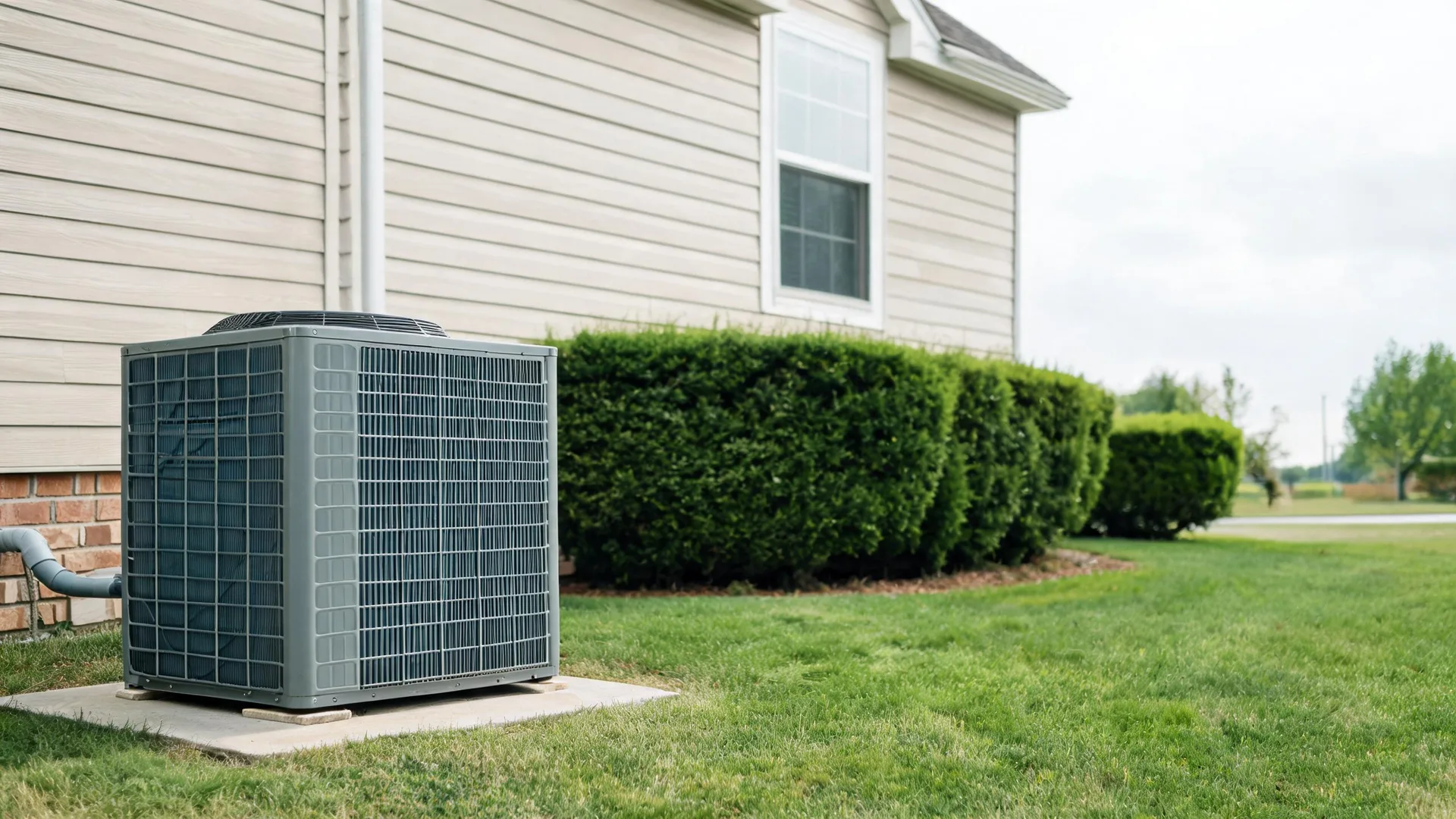
Pull the air filter and hold it up to a light. If you can't see light through it, that's choking off airflow and making the whole system work harder. Then walk outside and look at the condenser. Clear away leaves, grass clippings or anything piled against the cabinet, and check that the fan on top isn't blocked or bent. These are the things worth touching yourself. Anything involving the refrigerant lines, the electrical connections or the coil itself is a job for someone licensed to open that cabinet.

An outdoor air conditioning condenser unit installed beside the exterior wall of a blue vinyl-sided house at sunset.

A new air conditioner would cut about $60 a year off cooling for a typical Lexington County home.

  • A new one at the federal minimum, 14.3 SEER2$400 a year
  • An older air conditioner$460 a year

Estimates for a typical Lexington County home, compared with an older unit built to the previous federal minimum, from EIA household energy data, South Carolina fuel prices and NOAA climate normals. Your home will differ.

Repair makes sense when a part like a capacitor or contactor has failed.

Replacement makes sense when the compressor has failed or the system uses R-22 refrigerant, which is no longer made.

A good tech weighs a repair against replacement by asking what broke and why, not just what it costs to fix. A capacitor or a contactor is a part that wears out on its own schedule, and swapping it brings the system back to full health. That's a clean repair, worth doing almost every time. A coil that's corroded through, or a compressor that's seized, is a different story, because those failures often point to a system that's been stressed for a while, and fixing one part doesn't undo that. The question is whether what failed is a wearable part doing what wearable parts do, or a core part telling you the whole system is tired. Most repairs are the first kind.