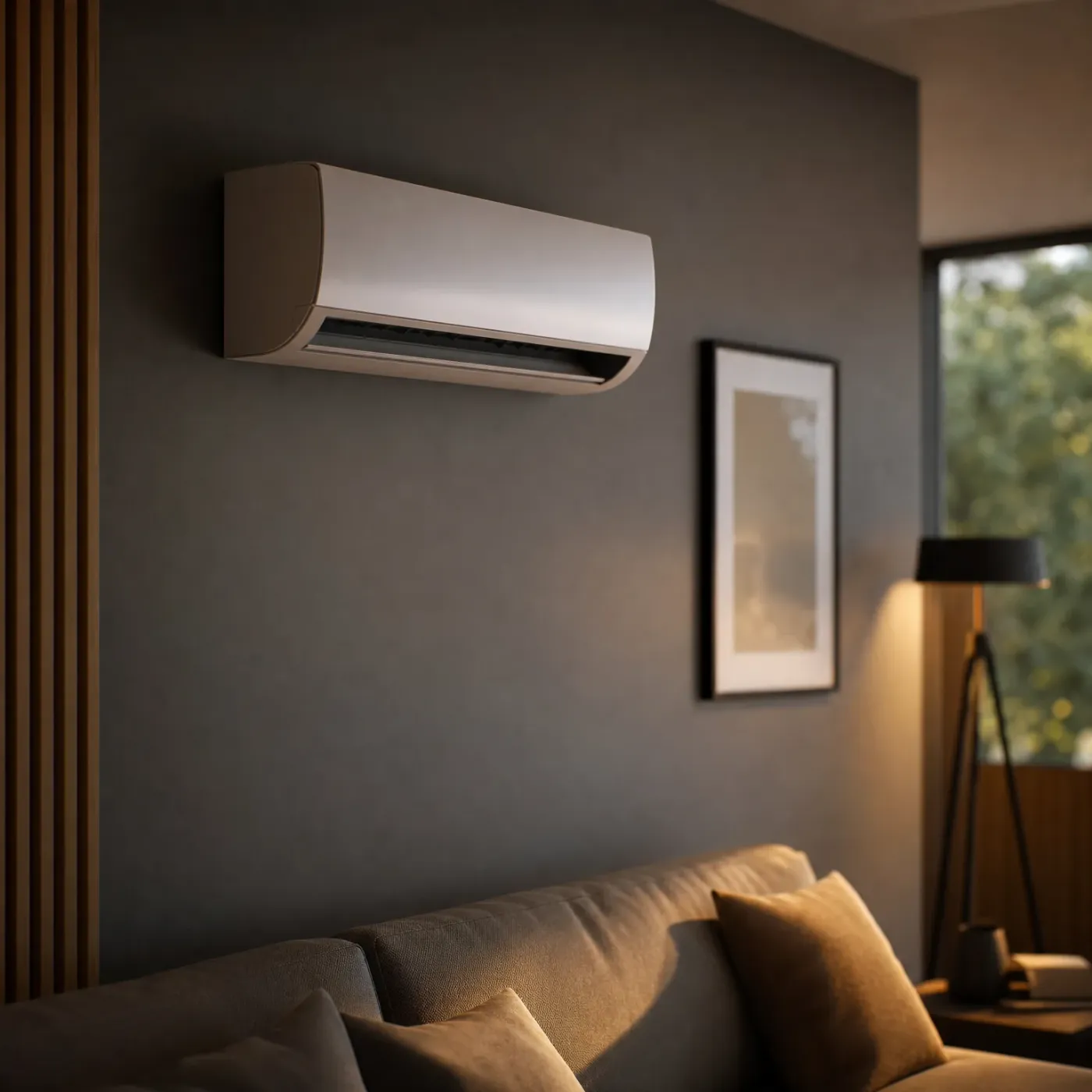














A white wall-mounted mini-split indoor unit on a gray interior wall above a beige sofa, with a framed picture, a floor lamp, wood slat wall trim, and a window showing green foliage.

A local pro for your mini split installation

Can a mini split cool a whole South Carolina home

One mini split can cool a room, maybe two. Whether it can cool your whole South Carolina house depends on how big the place is, how it's laid out, and whether one or more units were sized for that from the start. That takes a real look at your home, not a guess. Answer a few questions and a contractor who installs these systems in South Carolina homes will reach out, so you're not the one stuck figuring it out alone.

Get matched

A single mini split can cool a whole South Carolina home if it was sized and placed for that job, but most single units can't on their own. One indoor head cools the room it's in well and the rooms next to it less and less the farther the air has to travel. In a muggy South Carolina summer, a house with closed doors and separate bedrooms will have rooms that stay warm and humid while the room with the unit feels fine. Whole-house cooling with mini splits usually means more than one indoor unit, each sized to the room or zone it serves, run off one or more outdoor condensers. Whether that matches what's installed in your home now depends on how it was set up to begin with. If one head is doing all the work in a home built for more than that, the rooms farthest from it are the ones struggling.

A gray-haired woman in a cream knit sweater stands in a dimly lit kitchen at night, looking to her right, with a round loaf of bread in the foreground and a dark window and potted plant behind her.
A woman and a sleeping child wrapped together in a cream knitted blanket on a couch, with a potted plant, framed photo and lit lamp in the background.

How many mini split units do I need for my whole house?

A single mini split head covers the area around it, so once you're trying to reach every bedroom and the living room, the question turns into how many heads and compressors the job actually needs, not whether one unit will stretch far enough.

One per room or zone, run off one or more outdoor compressors

A mini split system splits a house into zones, and each zone gets its own indoor head, usually one per bedroom plus one for the main living area. Those heads can run off a single outdoor compressor, if it's sized for all of them, or off more than one compressor on a larger home. A contractor figures the number by room size, ceiling height, window exposure and how much heat South Carolina summers push through the walls and roof. A small house might need three or four heads. A larger one with more rooms to cover can need six or more, sometimes split across two outdoor units. The layout of your house decides the count, not a general rule.

A single-story brick house with a hipped shingle roof, large front windows and a central door, fronted by a wide paved driveway with sun flare, surrounded by green deciduous trees.

A summer dew point averaging 69°F across June, July and August, as recorded in South Carolina, is thick, sticky air, the kind that sits on your skin even after the house feels cool. That's the load your mini split is actually fighting all summer, not just the temperature on the thermostat. A single head can chill the air in a room fast, but pulling that much moisture out of a whole house takes more than one unit working alone. If rooms away from the indoor head stay cool but feel damp, that's the air humidity catching up with a system that isn't sized to cover the whole place.

NASA POWER T2MDEW county cells weighted by homes

A woman with long wavy brown hair in a grey ribbed sweater sits on a couch indoors, looking toward a window, with a potted palm-like plant and fireplace behind her.
A woman with long brown hair wearing a green V-neck top and beige cardigan sits on a light sofa, looking off to the side, with a dining table, lamp and framed picture in the background.
A woman with long dark hair in a cream knit sweater sits on a beige sofa indoors, looking toward a bright window with a houseplant and framed picture in the background.
A woman with long dark hair in a green knit sweater sits on a couch indoors, smiling and looking toward a window with a blurred room behind her.

Power costs 15.12 cents per kilowatt-hour statewide

At 15.12 cents a kilowatt-hour, the cost of cooling your house comes down to how well the system matches it. A mini split sized to cover every room runs efficiently all summer. One struggling to reach rooms it was never meant to cool runs longer and harder to do it, and that shows up on your bill.

EIA-861 2025 statewide residential average

What an undersized system costs you

  • A single-head mini split can leave bedrooms down the hall five or six degrees warmer than the room with the unit.
  • Closed doors make it worse, since a mini split depends on air moving freely between rooms to share the cooling at all.
  • With South Carolina's humidity, an undersized setup can leave the house feeling damp and clammy even when the thermostat looks fine.
  • Running one head harder to try to cool rooms it wasn't sized for shows up as a higher bill without the comfort to match.
  • A system sized room by room from the start keeps every bedroom and the living room within reach of its own head or zone.
  • Guessing at coverage now often means paying twice, once for the wrong setup and again to add what the house actually needed.

You'll feel an undersized setup before you ever see a number on a bill. The room with the indoor head feels fine. Walk down the hall and the air gets heavier, warmer, the kind of warm that makes you reach for a fan instead of trusting the thermostat. Close a bedroom door to keep the cold in and you've cut off the only path that cooling had to reach that room at all. In South Carolina, that gap isn't just temperature. The humidity that rides along with the heat all summer doesn't leave just because the number on the wall looks right. A house can read 74 degrees and still feel damp in the rooms farthest from the unit, because moisture builds up wherever the air isn't moving enough to carry it out. Pushing the one head harder doesn't close that gap. It just means the compressor runs longer trying to cool rooms it was never placed to reach, and that shows up on your power bill without making anyone in those far rooms more comfortable. The fix isn't a bigger single unit. It's a system where every bedroom and the living room has a head or a zone built for it from the start, so the air doesn't have to travel to do its job. Get that sizing wrong the first time and you're often back to pay for a second round, this time for the coverage the house needed from day one.

A white wall-mounted mini-split indoor unit high on a beige interior wall, with a potted olive-like tree at right and an armchair and window visible through a doorway at left.
A mini split sized and placed to match your home cools every room it was designed for, with clean coils and clear airflow doing the work.
A wall-mounted mini-split air conditioner indoor unit with visible dust and staining, installed on a beige interior wall below white crown molding.
A mini split fighting years of dust on its coils and vents loses cooling capacity right when South Carolina humidity asks the most of it.
  1. A contractor measures every room and checks window and wall exposure.

  2. The load numbers decide how many indoor heads the house needs.

  3. Each head gets placed where it can reach the whole room.

  4. Outdoor compressors get matched and sized to the indoor heads.

A dusty, stained white wall-mounted mini-split air conditioner indoor unit installed high on a plain off-white interior wall near the ceiling.
Before you get your mini split installation
A white wall-mounted mini-split air conditioner unit installed high on a beige interior wall below white crown molding, with a window and woven shade at the left edge showing green foliage outside.
After you get your mini split installation

Get the right pro for your mini split

Once you send the form, finding a pro is off your list.

Sending the form costs nothing.

A white wall-mounted mini-split air conditioner on a beige interior wall, with a window at left showing trees and a wooden fence, and dark wood flooring below.

Reaching every corner of the room

This is what a mini split looks like doing its job. Air moves out across the ceiling and down into the space, and everyone in that room feels it within a few minutes. The rooms nearby share in it too, as long as doors stay open and air has a path to travel.


A white wall-mounted mini-split air conditioner indoor unit with dark louvered vents, installed near the ceiling on a beige wall below white crown molding.

Losing ground to dust and distance

This one has years of dust built up on the coil and louvers, and it shows. A unit in this shape can't move the air it was built to move, so the bedrooms down the hall go without while it struggles just to cool the room it's in.

Why does one room feel fine while another doesn't?

You walk from the room with the indoor head into a bedroom down the hall and feel the difference right away. That room takes longer to cool, or never quite gets there, and by late afternoon it's noticeably warmer than where the unit is mounted. Closed doors make it worse. A fan running in the hallway helps a little and not enough. On the muggiest days the air in that far room can feel damp as well as warm, since it's not getting the same airflow the rest of the house is. None of this means the unit is broken. It usually means it was never meant to cool that room in the first place, and that's worth knowing before another summer goes by.

A white wall-mounted mini-split indoor unit installed high on a gray interior wall, with a window at left and part of a light gray sofa with a dark cushion at lower right.

Working the way it should

A clean mini split moves air out across the ceiling and down into the room without strain. The coils stay clear, the vents stay open, and the unit pulls the humidity down along with the temperature. That's what keeps the room next to it comfortable too, not just the one it's mounted in.

A white wall-mounted mini-split air conditioner indoor unit with visible dust and staining along its lower vent, installed on a plain pale wall.

Losing the fight

Dirt and mold along the vents and lower casing choke off airflow before it leaves the unit. A mini split in this shape can't push cooling past the room it's in, let alone share it down the hall. South Carolina's humidity gets in through the gap it leaves behind.

One Zone or Several

One zone

  • One outdoor compressor runs one indoor head, so the whole system costs less to install and takes up less space outside.
  • The room with the head cools fast and holds its humidity down well, since all the capacity is working for that one space.
  • Rooms down the hall depend on doors staying open and air finding its way there, which South Carolina humidity makes harder to pull off.
  • A single zone gives you one thermostat and one setting for the house, which means no room gets its own comfort level.
  • If the load numbers for your home are low enough, one properly sized head can be enough, but that's unusual for a full house.
  • Adding a second zone later means another outdoor unit and another line set, not just flipping a switch on what's already there.

Multiple zones

  • Each room or living area gets its own indoor head, sized for that space instead of sharing capacity with rooms down the hall.
  • Bedrooms stay close to the temperature you set them at, even on the humid afternoons when a single zone loses ground.
  • Someone can run their bedroom cooler at night without changing the temperature everywhere else in the house.
  • More indoor heads means more lines running to the outdoor compressors and more coils and filters to keep clean.
  • A multi-zone system costs more upfront than one head, since you're paying for coverage of the whole house from day one.
  • Matching the right number of heads and the right compressor size to your home takes a load calculation, not a guess based on square footage.
A white wall-mounted mini-split air conditioner unit installed high on a plain beige wall near the ceiling, with empty wall space to the right.

A house with one small unit

Say the mini split sits in the living room. That room holds its temperature fine through a July afternoon. The kitchen next to it does alright too, since the air can still move that far. But the bedrooms down the hall are a different story, especially with the doors closed at night. Those rooms depend on air reaching them secondhand, and in South Carolina humidity, secondhand air doesn't carry much relief by the time it gets there.

A white wall-mounted mini-split air conditioner indoor unit on a plain light-colored wall, with a beige curtain at the right edge of the frame.

A house built around the load

Now say the same house had its heads placed room by room, sized against what a contractor measured for windows, walls and square footage. Each bedroom has its own head or shares one sized to reach it directly. Nobody is waiting on air to travel down a hallway. The living room, the kitchen, the bedrooms all land near the same temperature, and whoever is home doesn't have to pick which room to be comfortable in.

A man seen from behind raises his hand to wave at a woman standing in the open front doorway of a single-story house with gray shingle siding, white columns and a gabled porch entry.

So, can one cool the whole house

A mini split can cool your whole South Carolina home. Whether yours does comes down to whether it was sized and placed for that job, with enough heads to reach every room and a compressor matched to carry all of them through a muggy July. Checking that against your own house, room by room, isn't something you can do from the specs on a box.

That's the part a contractor walks through with you, looking at your layout and your current setup and telling you plainly whether it's doing what it should or falling short somewhere. Once you send the request, you're not the one tracking down who can take a look. You'll hear from someone who handles this, and the house you've been keeping comfortable for everyone in it gets the attention it actually needs.

A gray upholstered sofa with a textured cushion sits beside a dark round side table holding a vase of green foliage, with a table lamp and sheer-curtained window behind.
A white wall-mounted mini-split air conditioner on a dark gray interior wall, with a flat screen at lower left and a green leafy plant at lower right.

A pro who works on mini splits

New system or replacementMini-splitSouth Carolina
Step 1 of 2

What ZIP code is the job in?





