

Is a mini split good for an older South Carolina home

A local installer who puts in mini splits gets your project.

Connect with a pro

Is a mini split good for an older home in South Carolina?

Older homes in South Carolina often don't have ductwork built for central air, or the ducts they do have are undersized, leaky, or run through a hot attic. If your heat is electric baseboard or an old wall unit is struggling to keep up with the humidity, you're probably wondering whether a mini split is worth putting in rather than tearing into walls for new ductwork.

Yes, a mini split works well in an older South Carolina home

A mini split doesn't need ductwork, so it sidesteps the biggest obstacle in an older house: no tearing open walls or ceilings to run supply lines. Each indoor unit cools and heats just the room it's mounted in, which matters here because South Carolina summers are muggy and a mini split pulls moisture out of the air as it cools, something electric baseboard heat can't do at all in winter. For a house that currently heats with electric resistance heat, switching that load to a mini split's heat pump can mean steadier comfort room to room, since one system is handling both jobs instead of a furnace and a window unit fighting each other.

A white wall-mounted mini-split indoor unit installed high on a gray interior wall, with a sofa, dark table and window visible in an adjoining room to the right.

Working as it should

A mini split that's keeping up looks like this: steady airflow, quiet operation, no stains on the casing. In an older home without ductwork, this is what good cooling looks like. The wall unit does its job and the room holds a steady temperature even on a muggy July afternoon.


A wall-mounted mini-split air conditioner indoor unit with a dusty beige casing and dark louvered vent, installed near the ceiling on a plain beige wall.

Signs of trouble

Yellowing plastic and dust caked on the louvers mean the unit hasn't been serviced in a while. In an older home, that buildup can point to a clogged filter or a coil that isn't draining right. Left alone, it works harder and cools less, and the stains won't wipe off.

A gray-haired, bearded man in a dark coat dusted with snow stands smiling in a dimly lit room with a lamp, mirror, framed art, and a sofa in the background.
An older man with white hair and a beard, wearing a dark snow-dusted coat and scarf, stands in a warmly lit interior hallway with a framed landscape picture, a table lamp and a potted plant behind him, and a snowy view through a window at left.
An older man in a dark snow-flecked overcoat and scarf stands smiling in a warmly lit home entryway, with a glass-paned door showing darkness outside and a lamp-lit room visible through a doorway behind him.
An older man with gray hair and a beard, wearing a dark snow-dusted jacket and scarf, stands smiling in a warmly lit interior hallway with a lit table lamp, a vase of dried branches, and a framed picture in the background.

A mini split doesn't run on one setting the way a window unit does. Inside, each head has its own thermostat, so the room that used to lag behind now holds its own temperature. Outside, the compressor isn't just on or off. It ramps up and down to match what the room needs, which is why the air feels steadier instead of blasting cold then cutting out. That same process pulls moisture out of the air as it cools, which matters here even on days that aren't that hot but still feel thick. Getting one in doesn't mean opening up the attic. The line that runs between the outdoor unit and the indoor head is a small refrigerant line through the wall, not a duct run that has to be sized and sealed. Since most houses here heat with electricity, a mini split that also heats can take over from baseboard on the milder days. One thing does take some thought: where the indoor head goes, since it needs a clear path for the condensate to drain.

How a mini split actually works

  • Each indoor head has its own thermostat, so a room that stayed hot with window units can finally hold its own temperature.
  • The outdoor compressor adjusts its speed to match the load instead of just switching on and off, which is why the air coming out feels steadier.
  • A mini split pulls moisture out of the air as it cools, which matters in a muggy climate even on days that aren't that hot.
  • Installation runs a small refrigerant line set through a wall, not a duct system, so there's no attic ductwork to size or seal.
  • Since most homes here heat with electricity, a mini split that also heats can take over from baseboard heat on the mild days and cut how hard it has to work.
  • The indoor head needs a clear path for drainage, so where it sits on the wall affects how well the condensate line keeps up.
A white wall-mounted mini-split air conditioner unit high on a light gray interior wall, with a beige curtain and window at the left and wood-look flooring below.
A mini split cooling a room well runs quiet, with steady airflow and a clean white casing.
A dusty white wall-mounted mini-split air conditioner indoor unit with open louvers, installed near the ceiling on a plain light-colored wall.
Dust and dark grime on the vents mean the filter or coil needs attention before the unit struggles through another South Carolina summer.

Is your mini split keeping up with your house

Walk through the rooms it covers. If one of them stays warm and sticky while the rest feel fine, the head in that room may be sized wrong for the space or losing ground to heat coming through an uninsulated wall. Listen for it running most of the day without the room cooling down, or short cycling, shutting off fast and starting again. Check the wall unit for water stains underneath or ice on the coil you can see through the vents. In an older house carrying the cooling load without ducts, a mini split that's struggling can mean rooms stay humid enough for mold to start in the corners, and a compressor that keeps straining can wear out well before it should.

A woman wrapped in a thick beige fleece blanket sits on a sofa with an open book on her lap, beside a lit table lamp, with a frost-covered window behind her.
A smiling older woman with gray hair in a cream knit sweater stands in a dimly lit kitchen beside a window showing snow outside, with a round loaf of bread on the counter in the foreground.
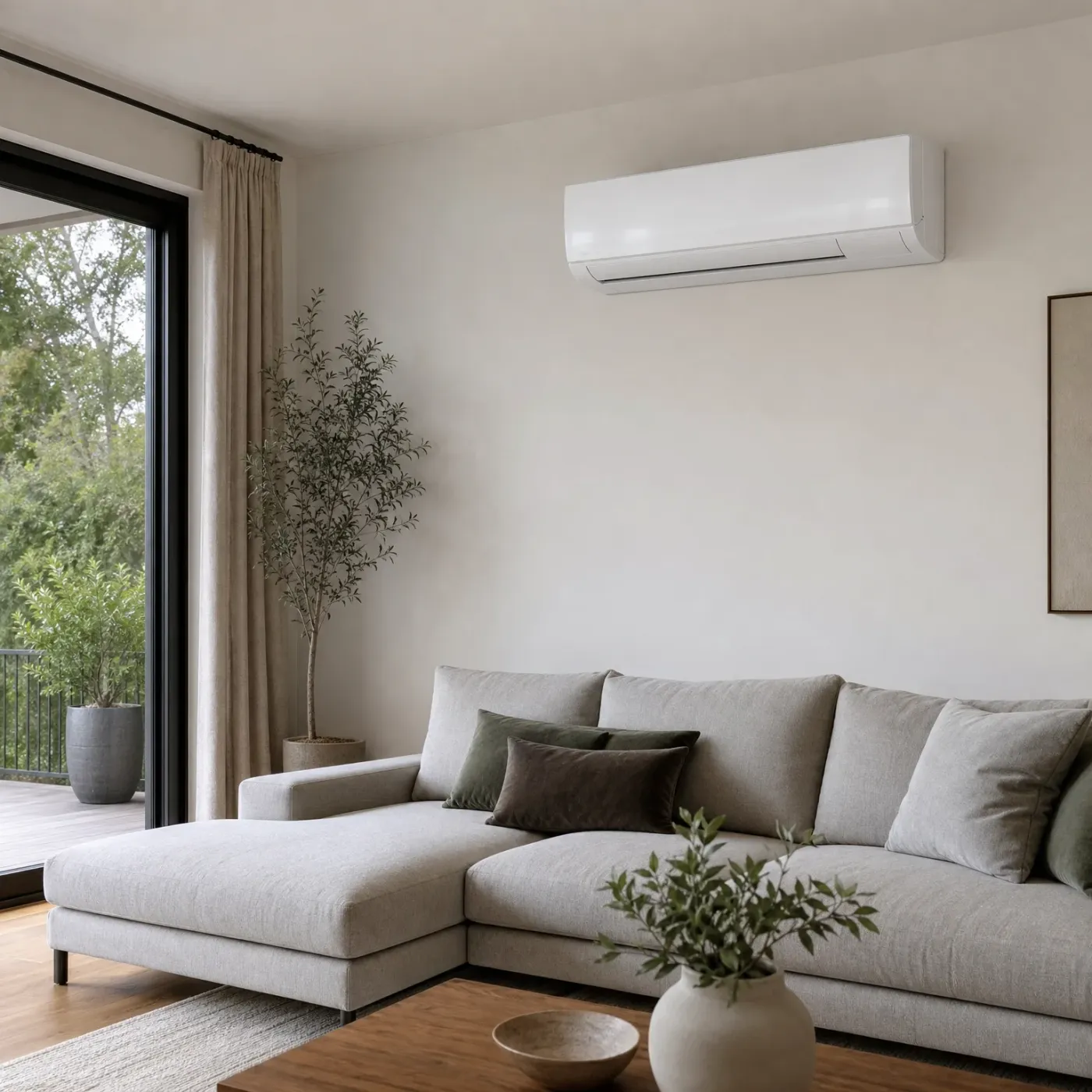
Living room with a grey sectional sofa, wall-mounted white mini-split air conditioner above it, a potted tree beside sliding glass doors with beige curtains, and a wooden coffee table with a vase of foliage in the foreground.

Get your mini split to the right pro

Skip collecting and comparing quotes for the new mini split.

Get in touch with a local installer about a new mini split.

Find a pro near me

It costs nothing to send, and you don't have to hire anyone.

A man in a dark blue shirt stands in an open front doorway of a stucco and wood-clad house, facing a blond woman seen from behind in the foreground on a stone walkway.

What a mini split changes in your house

If you've been cooling a room with a window unit, or an old wall AC that only runs on high or off, you know the room never quite settles. A mini split head holds a room at the temperature you set it, and it keeps holding it, because the compressor outside is adjusting its speed instead of just cycling on and off. That matters more in a house with no ductwork, where each room has been on its own all along.

You also don't have to track down who installs these, size the unit for your room, and figure out whether your electrical panel can take it. Getting matched with a contractor who handles mini splits in older South Carolina homes means one call explains your house once, and someone who already knows this kind of install reaches out to you.

A dark ceramic mug on a round wooden table beside a light grey sofa with a woven cushion and knit throw, with a window, potted plant, floor lamp and wooden cabinet blurred in the background.
A white wall-mounted mini-split air conditioner installed near the ceiling on a plain beige interior wall.

Running the way it should

A mini split working right sits quiet near the ceiling, casing clean, air moving steady out of the grille. You'd walk past it and not think about it. That's what it covers doing its job, and the room holding a set temperature without the unit straining.

A dusty, discolored wall-mounted mini-split air conditioner unit near the ceiling of a plain beige interior wall.

Showing its age

Discoloration and dust built up on the casing like this usually mean years of a dirty filter or a coil that never got cleaned. It can still be running, but it's working harder than it should, and a South Carolina summer will find that weakness.

A wall-mounted mini-split air conditioner indoor unit with a discolored cream plastic casing and dusty outlet vanes, installed high on a plain light-colored interior wall near the ceiling.
Before you get your mini split installation
A white wall-mounted mini-split air conditioner installed high on a beige interior wall near the ceiling molding, with a light curtain and curtain rod at the left edge.
After you get your mini split installation

Power costs 15.12 cents per kilowatt-hour statewide

At 15.12 cents a kilowatt-hour, running a mini split costs about what running anything else electric does here. Since each head only cools the room it's in, you're not paying to condition space nobody's using, which matters more in an older house than the rate itself does.

EIA-861 2025 statewide residential average

Where this leaves your home

  • A mini split suits an older South Carolina home that lacks ductwork or has undersized, leaky ducts running through a hot attic.
  • Each indoor head cools only the room it serves, so a sticky back bedroom can finally hold its own temperature.
  • Running cost sits close to what any other electric appliance costs here, since power is priced typical for the area.
  • A unit that's struggling shows up as dust on the vents, stains on the casing, or a room that never quite cools.
  • Finding a contractor who installs these well usually means several calls, repeating the same details about your house, and sorting through quotes that are hard to compare.
  • Matching with one contractor who already knows the install work this kind of house needs skips that search.

A mini split fits an older South Carolina home for a plain reason. It doesn't need the ductwork your house may never have had, and it puts the cooling right where you need it instead of chasing leaks through a hot attic. The back bedroom that never cooled with a window unit gets its own head and its own thermostat, so it finally holds the temperature you set. Running it costs about what any other electric appliance costs here, and since each head only cools its own room, you're not paying to condition space nobody's using. When one starts to struggle, it shows itself plainly: dust on the vents, a stain on the casing, a room that stays sticky no matter the setting.

Getting to that point usually means work that has nothing to do with the mini split itself. You call a handful of installers, describe your house and its wiring the same way each time, then sit with quotes that list different things and price them differently, trying to tell which one actually covers the job. None of that tells you whether the unit will be sized right for your rooms or whether the person installing it has done this in a house like yours before.

Matching with a contractor who already knows this kind of install skips that part. You answer once, and the search for who to call is done.

A white wall-mounted mini-split air conditioner on a dark gray interior wall above a gray sofa, with a window and curtain at left, a potted olive-like plant at right, and a black vase and bowl on a table in the foreground.

The right pro for this job

Skip the round of in-home estimates for a new mini split.

New system or replacementMini-splitSouth Carolina
Step 1 of 2

What ZIP code is the job in?