Electricity here runs 14.23 cents a kilowatt-hour
South Carolina power costs more than it does in a lot of states. A mini split that runs on less power keeps that rate from adding up the way an old window unit or baseboard heat would.

Takes about a minute. No obligation.
South Carolina power costs more than it does in a lot of states. A mini split that runs on less power keeps that rate from adding up the way an old window unit or baseboard heat would.
When you're comparing mini split systems for Abbeville, the efficiency rating matters as much as the price tag. A unit that uses less power to do the same job is the one that costs less to live with once it's installed.
NOAA nClimDiv, 1991–2020 normals
Half the homes in Abbeville County were built in 1980 or earlier, half in 1980 or later.
A mini split is sized to the room it heats and cools, not to the age of the house it's in.



Abbeville County has seen 35 severe weather events over 2015 to 2024, mostly damaging wind with a few hail storms and tornadoes mixed in. None of that calls for anything special in a mini split. A unit sized to the room and rated for standard efficiency handles this weather the same way it would anywhere nearby. If the power goes out, a mini split comes back on by itself once service is restored. There's no pilot to relight and no setting to reset.
Abbeville sits in climate zone 3A, and any mini split sold here has to clear 14.3 SEER2 for cooling and 7.5 HSPF2 for heating. That floor is already set before you start comparing units. A system that clears it qualifies for the federal credit on top of the purchase. Worth checking as you narrow down options.
Find a contractorCooling in Abbeville runs May through September, five months of the compressor working most days. A mini split installed in April gets tested and adjusted before any of that load hits it. Wait until the heat is already on and any adjustment happens with the house uncomfortable and the unit running flat out. Going in before the season also means it's matched to the room and running clean from the first day instead of settling in while you're already relying on it.
SEER2 rates how the unit cools, HSPF2 rates how it heats. A mini split carries both because the same outdoor unit handles both jobs through a reversing valve instead of a separate furnace. Look at both numbers, not just one, if the system is replacing a furnace as well as an air conditioner.
A mini split only hits its rated efficiency when it's matched to the room and free to run steady. One that's too big for the space cycles on and off instead of holding a steady run, and that costs more than the label suggests. A dirty coil or a blocked vent makes the compressor work harder for the same output no matter what's printed on it.
What happens to the old system depends on what it is. A window unit or portable AC just gets hauled off, nothing to it. Electric baseboard heaters get pulled off the wall and the circuit gets capped or reused for the new unit. If the house was heating and cooling with a central system, the old outdoor condenser and indoor coil come out, and the ductwork either gets capped off or left in place if only part of the house is converting. The refrigerant in the old system has to be recovered by the contractor before any of it gets cut apart or hauled away, that's a legal requirement, not an option. None of this is a reason to delay replacing a system that's already struggling.
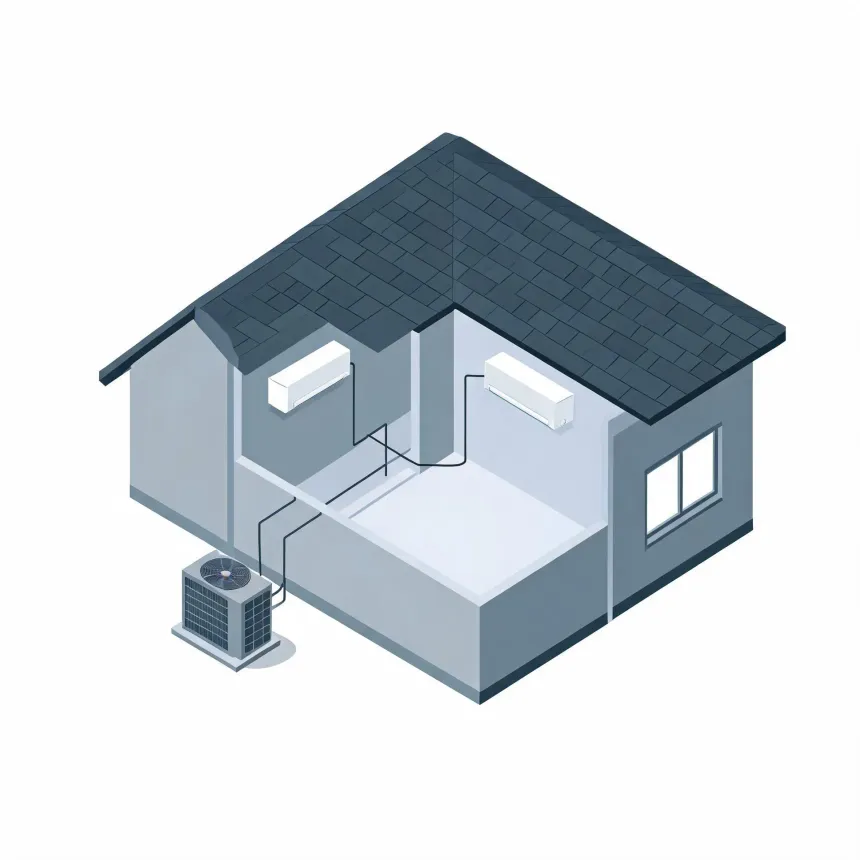
Installation starts with the outdoor unit and where the line set will run between it and the indoor head. The installer mounts the indoor unit on the wall or ceiling, drills a small hole through to the outside, and runs the refrigerant lines, drain line and power through it. Once both halves are in place, the lines get connected and the system is pressure tested before any refrigerant moves, since a leak at a joint means it has to be opened back up and resealed. After that the system gets charged, and the installer checks the charge against what the line length calls for rather than just filling it and walking away. The last step is running it in both cooling and heating, checking the temperature split at the vent and making sure the condensate drains the way it should instead of backing up into the wall.