A dark, minimalist bedroom featuring a sleeping cat on a grey-quilted bed, a wall-mounted air-conditioning unit, warm cove ceiling lighting, and a pendant lamp illuminating the bedside table.

Mini Split Installation in Aiken, SC

Tell us about the job

Takes about a minute. No obligation.

New system or replacementMini-splitAiken County, SC
Step 1 of 2

What ZIP code is the job in?

Weather here is hard on outdoor units

Aiken County logged 254 severe weather events between 2015 and 2024, including dozens of hail events. A mini split's outdoor unit sits exposed to all of it, so where it gets mounted and what shields it matters as much as the install itself.

Power cuts last longer than people expect

Nearly half of South Carolina households went at least 24 hours without power in 2024. A mini split needs electricity to run, same as any heat pump system, so an outage means no heat or cooling until the power is back.

5 months
November through March, your system heats
5 months
May through September, it cools
36°F
the average winter night it heats against
91°F
the average summer afternoon it cools against
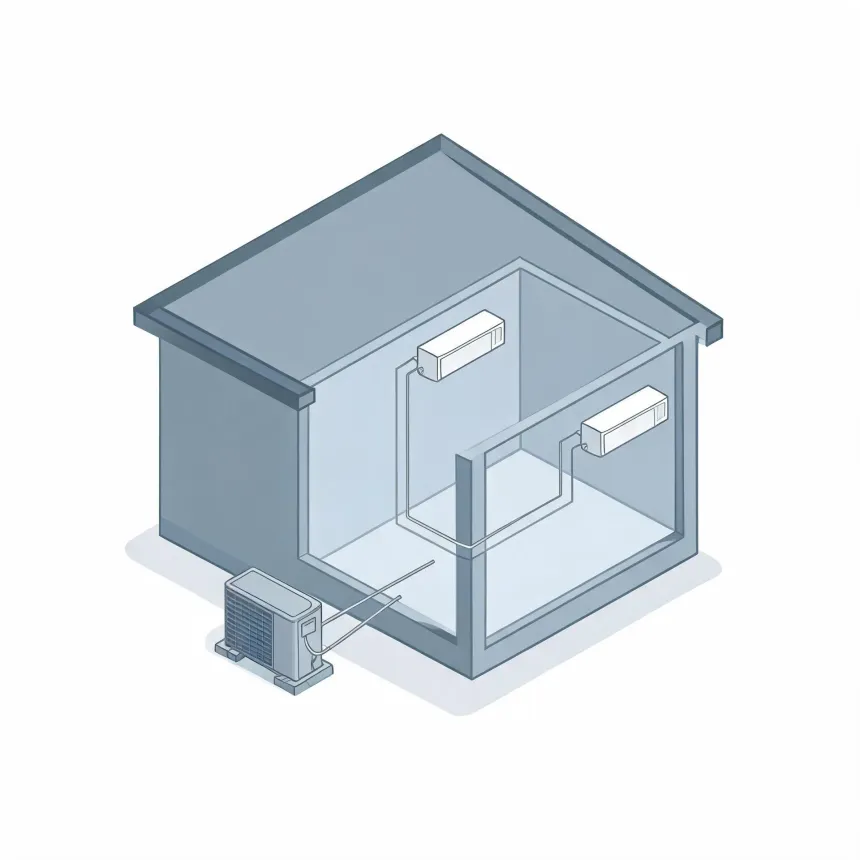
Isometric line illustration of a cutaway building interior with two wall-mounted indoor air conditioning units connected by piping to an outdoor condenser unit on the ground outside.
Your system heats November through March and cools May through September.

NOAA nClimDiv, 1991–2020 normals

South Carolina electricity ran 14.23 cents per kilowatthour in 2024.

A mini split that holds its efficiency keeps that rate from adding up on every bill.

Five months of cooling at 91 degrees is real work for a compressor

Cooling runs May through September
Summer afternoons average 91°F
185 damaging wind events from 2015 to 2024

Cooling starts in May here, so April is the month to get a mini split in. Wait until the first hot week and you're scheduling around a system that's already struggling, not planning ahead. A contractor can size the unit, run the line set, and mount the outdoor unit with room to spare when there's no pressure to rush the job. That matters more in a county that sees the hail and storms this one does. Get it done in April and the system is already proven out before it has to run five months straight.

Any system going in has to clear this region's efficiency floor

Aiken County falls under zone 3A, and any mini split installed here has to meet the federal minimum of 14.3 SEER2 for cooling and 7.5 HSPF2 for heating. That floor is what a contractor starts from when sizing your system, not an upgrade option. A federal tax credit is available on qualifying equipment, worth asking about when you compare units.

Find a contractor
A beige split-system air conditioner outdoor condenser unit mounted on metal wall brackets atop a stucco wall.

This runs hardest in the months you need it most

Five months of 91 degree afternoons means a mini split here spends most of the summer working close to its limit. That makes sizing the part worth getting right before anything else. A system sized too big short cycles, switching on and off instead of settling into steady running. One sized too small just runs flat out all day and still falls behind once the afternoon heat sets in. A contractor sizing the unit should be working from this county's summers, not a national average.

How many rooms it has to reach

A single zone covering one room costs less to put in than a multi-zone setup feeding several rooms off one outdoor unit. Each indoor head needs its own line set and its own spot on the wall or ceiling, and the outdoor unit has to be sized to carry all of them at once. More zones means more labor and more material before the equipment itself is even factored in.

What the line set has to get through

The refrigerant line runs from the outdoor unit to each indoor head through a hole drilled in the wall, and what that path crosses changes the job. A line set running straight through to an exterior wall is quick work. One that has to travel through an attic, drop down an interior wall, or clear framing and brick takes more time and more material, and that shows up in what the installation runs.

Ask how many indoor heads the system can actually run at once, not just how many it can physically connect to. Every outdoor unit has a limit on total capacity, and a contractor has to divide that across every room it serves. Ask what happens if you add a zone later, since some outdoor units have room to spare and others are maxed out from day one. Ask about the controls too. Some systems give each indoor head its own thermostat, others tie them together so one zone's setting drags on the rest. And ask what the warranty actually covers, because compressor coverage and labor coverage are not the same thing, and a system that's cheap to install can still be expensive to service if labor isn't included.

Install day starts with the outdoor unit placement and the line set path already decided, not figured out on the spot. The indoor head gets mounted on its bracket, the line set runs through the drilled wall hole, and the refrigerant lines get connected. Before any of that gets charged, a contractor pulls a vacuum on the line set and checks that it holds. Air or moisture left in the line lowers performance and can damage the compressor over time, so that check matters more than it looks like it should. Once the outdoor unit is set on its mount and the electrical is tied in, the system gets powered up and tested across every mode it has to run in. A tech worth hiring checks the line set connections for leaks before calling the job done. A slow leak will not show up as a problem until months later, when the system can no longer hold its charge.