





A white Southern-style house with a wraparound porch photographed at night, surrounded by Spanish moss-draped oak trees lit by landscape lights.

Mini Split Installation in Greenville, SC

Tell us about the job

Takes about a minute. No obligation.

New system or replacementMini-splitGreenville County, SC
Step 1 of 2

What ZIP code is the job in?

A mini split sized by square footage alone is a guess, and it usually guesses wrong. The right way is a load calculation, which looks at how much heat the space gains in summer and loses in winter, based on window area, insulation, ceiling height and which way the room faces. Oversize it and the unit short cycles, blasting cold air and shutting off before it ever pulls the moisture out of the room, which leaves it feeling damp and clammy. Undersize it and it runs flat out on the hottest and coldest days without ever catching up. Multi-zone systems add another layer, since the outdoor unit has to be matched to the combined load of every indoor head, not just added up room by room. A contractor who sizes it right is doing math most homeowners never see, and it is the difference between a system that disappears into the background and one you notice every day.

7 months
October through April, your system heats
5 months
May through September, it cools
34°F
the average winter night it heats against
87°F
the average summer afternoon it cools against
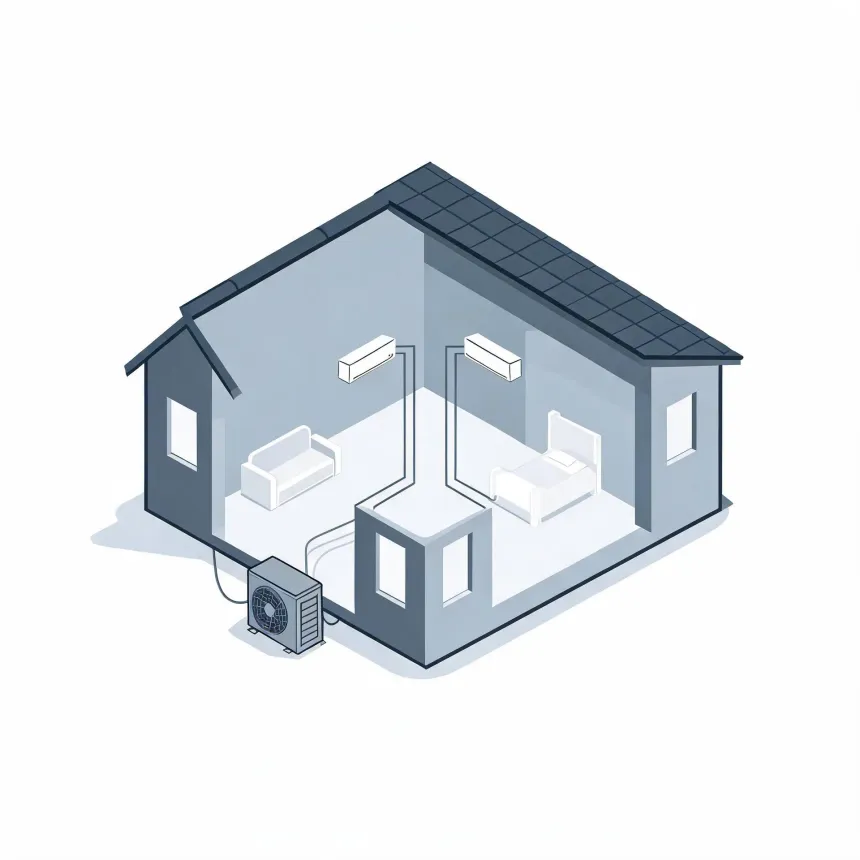
Isometric cutaway illustration of a small house showing two wall-mounted indoor air conditioning units connected by lines to a single outdoor condenser unit beside the building, with a sofa in one room and a bed in another.
Your system heats October through April and cools May through September.

NOAA nClimDiv, 1991–2020 normals

Homes in Greenville County run cooling May through September.

Install the mini split in April and it's ready before the first hot day, not scrambled together after it.

Most homes in Greenville County heat with electricity

56.9% of homes heat with electricity
Cooling runs May through September
Summer afternoons average 87°F

Greenville County is zone 3A, long summers, short mild winters, humid most of the year. A mini split here has to meet the federal minimum for a split-system heat pump, no matter how many indoor heads are on it. That means 14.3 SEER2 for cooling and 7.5 HSPF2 for heating. It's a floor, not a ceiling, so a contractor can still quote something that beats those numbers if the load calls for it. Anything manufactured this year already meets that standard. There's also a federal tax credit on qualifying heat pump installs, worth asking about when comparing quotes.

An efficient mini split earns its keep on every bill

Electricity here runs 14.23 cents per kilowatthour. A mini split moves heat instead of generating it, so it gets more warmth and cooling out of every one of those cents than straight electric heat does. Sizing it right, with a load calculation instead of a square footage guess, is what makes sure it actually runs at that efficiency.

Find a contractor
A man seen from behind in a dark work shirt and tan pants carries a worn canvas tool bag up concrete steps toward a dark green paneled front door, with a potted shrub at left.
A white mini-split air conditioner outdoor condenser unit mounted on metal brackets against a beige stucco exterior wall, with a blue sky and scattered clouds in the background.

Five months of summer, every year, on the unit outside

Cooling runs May through September here, and the afternoons it's working against average 87 degrees. That's five months of an outdoor unit sitting in direct heat, cycling on and off most of the day. Greenville also gets its share of damaging wind and hail, enough that the outdoor condenser has to sit through real storms, not just heat. A mini split sized and installed right handles that fine. One sized by guesswork is the one that starts struggling early instead of lasting.

The rating is tested, not promised

SEER2 and HSPF2 come from lab tests run the same way for every unit, so one system's number means the same thing as another's. It's not a guess by the manufacturer and not a marketing term. It tells you how much cooling or heating the system delivers for the power it draws, nothing about size or capacity. A higher number means more comfort per watt, not a bigger or stronger unit.

The install decides how close you get to it

A mini split's efficiency rating comes from a lab test with the refrigerant charge exact and the airflow where it should be. A unit installed with the wrong charge or a kinked line set will never hit the number on its own label. The rating is the ceiling for that equipment, and the work done hanging it is what decides how close the system lands to it.

The equipment is only one line on the quote. How many indoor heads the system needs, and how much capacity each one carries, moves the price more than almost anything else, since every head adds its own line set and its own labor. Where the outdoor unit can sit, and how far the line set has to run to reach each indoor head, changes how much copper and refrigerant line gets installed and how much conduit protects it along the way. A wall big enough for a clean mounting job is simple. A wall that needs bracing, or a line set that has to cross a long run of siding or brick, takes more time and more material. Electrical work is its own cost apart from the mini split itself, since a new dedicated circuit means running wire back to the panel, and an older panel without room for it means that gets addressed first. A multi-zone system also needs an outdoor unit matched to the combined load of every head running at once, not just the biggest room, so adding zones changes the size and cost of the outdoor unit too.

Install day starts with the outdoor unit and the indoor heads already chosen, so most of the work is running line set, not deciding on equipment. The installer mounts the indoor head first, usually high on an interior wall, then drills a single hole through to the outside for the refrigerant lines, the drain line and the electrical whip. Those get bundled together and run to the outdoor unit, through conduit wherever they cross open wall. Once everything's connected, the lines get pulled into a vacuum to clear out air and moisture before the refrigerant is released into the system. That vacuum test matters more than anything else that day, since any moisture left in the lines turns into acid once the system runs. After that the installer checks refrigerant pressure, confirms the indoor head is level and draining properly, and walks through the remote or thermostat with whoever's home.