




Single-story houses, one brick and one with light siding, both with covered porches, behind a mowed lawn and trimmed hedge, under large moss-draped oak branches.

Mini Split Installation in Kingstree, SC

Tell us about the job

Takes about a minute. No obligation.

New system or replacementMini-splitWilliamsburg County, SC
Step 1 of 2

What ZIP code is the job in?

A mini split runs on electricity, and South Carolina homes paid 14.23 cents per kilowatthour in 2024. That rate applies no matter what system you choose, so the difference shows up in how much electricity a system actually uses to do its job. A mini split cools and heats a room directly, with no ductwork losing air along the way. For a Kingstree home, that's one less place for the cost of that rate to add up. The unit you install now is what you'll be paying that rate against for years.

5 months
November through March, your system heats
5 months
May through September, it cools
37°F
the average winter night it heats against
90°F
the average summer afternoon it cools against
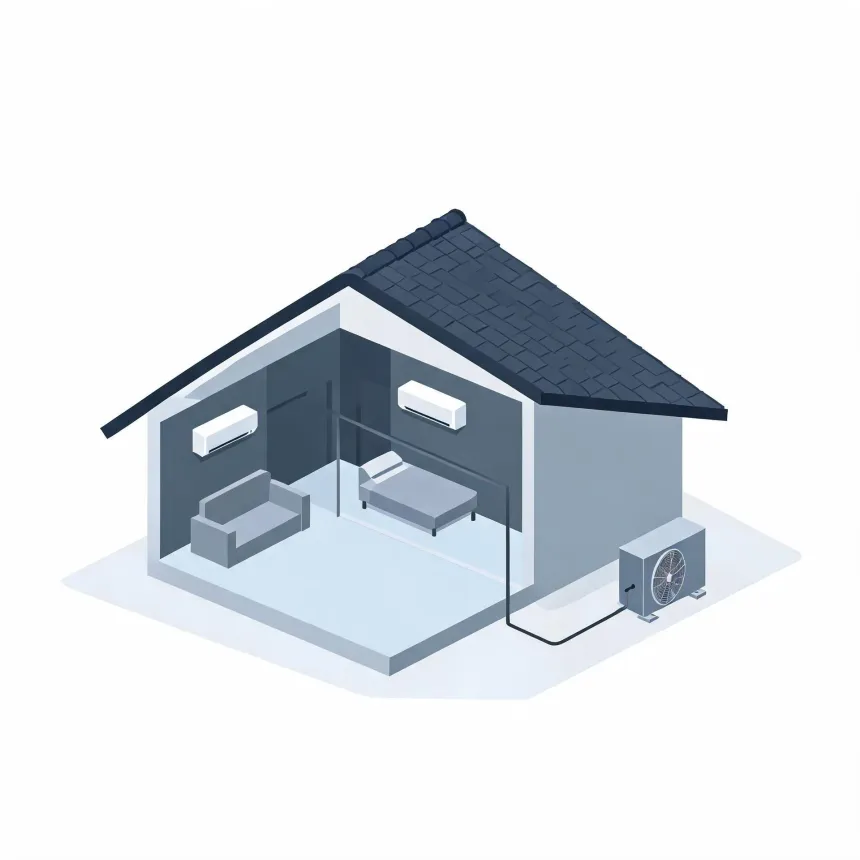
Isometric illustration of a cutaway house showing two wall-mounted indoor air conditioning units connected by a line to an outdoor condenser unit beside the building, with a sofa and bed inside.
Your system heats November through March and cools May through September.

NOAA nClimDiv, 1991–2020 normals

Taking out the old unit is part of the installation job, not something separate.

The new line set and mounting bracket rarely line up with what the old system left behind, so most of it comes out.

Five months of 90 degree afternoons is what your new system is sized against

Cooling runs May through September
Summer afternoons average 90°F
Power costs 14.23 cents a kWh statewide

Williamsburg County sees its share of rough weather, including damaging wind and the occasional hurricane passing through. None of that calls for an oversized mini split or some special storage model. A correctly sized system for this home and this climate is the right call, same as it would be anywhere else in the region. What matters more is what happens after a storm knocks the power out, since close to half of South Carolina households lost power for a full day or longer last year. A mini split comes back on by itself once power is restored. You won't need to relight anything or reset a pilot, which is one less thing to deal with when you're already cleaning up a yard full of branches.

A correctly sized mini split is the right fit here

Half the homes in Williamsburg County were built in 1985 or earlier, half in 1985 or later, and mobile homes make up close to 40 percent of the housing here. None of that changes what a mini split needs to do its job. A standard size, matched to the room, is the right call whether the home is older or newer, site built or mobile.

Find a contractor
A man in a cap, dark t-shirt and tan work pants walks up concrete steps toward a dark green front door, carrying a waxed canvas tool bag, with a potted shrub beside the entry.
A beige split-system air conditioner outdoor condenser unit mounted on metal wall brackets atop a stucco wall.

Sized for five months of this, not one bad week

Five months of summer here means the unit works through more 90 degree afternoons than most systems ever see. That's what the sizing has to match, not the hottest day you can picture. Get it wrong in either direction and the system is working against itself for all five months. Ask whoever quotes the job how they're sizing it for this house, and don't settle for a guess.

The room decides the size, not the brochure

A mini split is sized by working out how much heat a specific room gains in summer and loses in winter. That means measuring the room, counting the windows and checking which way they face, and looking at what's above and below it. A contractor who skips straight to a number without walking the room is guessing.
Oversized cools fast and still fails at the job

A unit that's too big chills the air quickly and shuts off before it pulls the moisture out of the room. The room feels cool but damp, and the compressor is cycling on and off far more than it should, which wears it down faster. Bigger isn't a safety margin here, it's a different problem.

The install itself is where the money moves around. Mounting the indoor head is quick work, but running the line set is not, especially if it has to cross an attic, drop inside a wall, or cut through brick or siding to reach outside. A straight shot from indoor unit to outdoor unit costs less than one that has to snake around framing or get fished through a finished ceiling. The electrical side matters too. Some mini splits can run on an existing circuit, others need a new dedicated line back to the panel, and if the panel itself is already full, that's another piece of work before the unit ever gets power. Where the outdoor unit sits counts as well, since it needs clearance to pull air through the coil and a solid, level pad to sit on. None of this shows up in a price until someone has actually looked at the walls, the attic, and the panel.

Installation day starts with the walk-through, confirming where the indoor head and outdoor unit will actually sit before anyone drills anything. The crew mounts the indoor unit on its bracket, then cuts a small hole through the wall for the line set, the refrigerant lines that connect it to the outdoor unit. Those lines get run, connected, and then the system is pressure tested before it's charged with refrigerant, since a leak found after the fact means opening the wall back up. The outdoor unit gets set on its pad, the electrical gets tied in, and only then does anyone power it on. Once it's running, a tech checks the temperature at the vent and confirms the line set connections are holding pressure. Testing takes longer than the mounting does, and that's by design.