Night view of illuminated white Southern-style houses with wraparound porches beneath Spanish moss-draped oak trees.

Mini Split Installation in Myrtle Beach, SC

Tell us about the job

Takes about a minute. No obligation.

New system or replacementMini-splitHorry County, SC
Step 1 of 2

What ZIP code is the job in?

Weather here is hard on outdoor units

Horry County logged 211 severe weather events between 2015 and 2024, including damaging wind and hail. A mini split's outdoor unit sits exposed to all of it, so where it's mounted and how it's shielded from wind-blown debris and hail matters as much as the install itself.

Power doesn't always stay on

Nearly half of South Carolina households went at least 24 hours without power in 2024. A mini split needs electricity to heat or cool, so if you're weighing a mini split against a backup plan for an outage, work that out with the installer before the system goes in, not after the next storm.

5 months
November through March, your system heats
5 months
May through September, it cools
37°F
the average winter night it heats against
89°F
the average summer afternoon it cools against
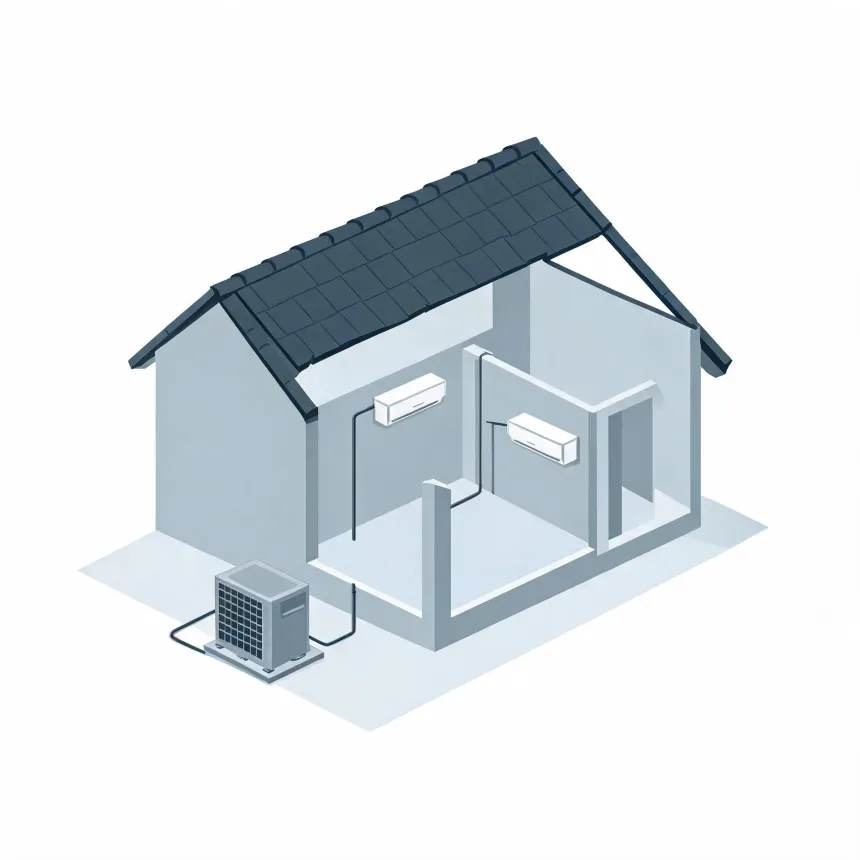
Isometric illustration of a cutaway house with a dark tiled gable roof, showing two wall-mounted indoor split air conditioning units connected by lines to an outdoor condenser unit on the ground outside.
Your system heats November through March and cools May through September.

NOAA nClimDiv, 1991–2020 normals

The efficiency rating on a mini split is a ratio, not a guarantee.

A unit sized wrong for the space it's cooling will never hit that number no matter what the label says.

Power here costs 14.23 cents a kilowatt-hour, and cooling runs May through September

Power costs 14.23 cents a kWh statewide
Cooling runs May through September
Summer afternoons average 89°F

Horry County sits in zone 3A, a warm, humid climate with mild winters and cooling that runs most of the year. Any mini split installed here has to meet the federal minimum set for that kind of climate. For a ductless heat pump, that means at least 14.3 SEER2 for cooling and 7.5 HSPF2 for heating, the same minimum that applies to central systems with ductwork. The standard doesn't carve out a separate, lower bar for ductless units. That rules out some of the cheaper models before you even get to picking a brand.

Most homes here already run on electricity, which is what a mini split needs

Electricity heats 86.4% of homes in Horry County. A mini split runs on electricity already, so it fits the setup most houses here already have. For homes on gas or propane now, the installer can walk you through what changes and what doesn't.

Find a contractor
A man in a backwards cap, dark long-sleeved shirt and brown work pants, seen from behind, carries a worn canvas tool bag up steps toward a dark green paneled front door beside a potted shrub.
A white mini-split air conditioner outdoor condenser unit mounted on metal brackets against a beige stucco exterior wall, with a blue sky and scattered clouds in the background.

What drives the number on your quote

How many indoor heads the system needs is what moves the price most. One head tied to one outdoor unit is a simpler job than several heads running off a single outdoor compressor, since each extra zone means another line set and another mounting job. Where the outdoor unit sits matters too. A wall mount close to where the lines pass through the house is a shorter, simpler run than a unit that needs a stand or pad somewhere further out. Electrical work can add to the job as well. If a circuit and disconnect already sit near the install point, that's one less thing to do. If not, wiring has to run from the panel, and that's its own work separate from hanging the unit. Then there's the path itself. Refrigerant lines, the condensate drain, and the power all have to reach the same spot. A straight shot through an exterior wall is a different job than one that has to work around framing or go up through an attic.

What happens to the old equipment

If a central system is coming out, the indoor coil, the outdoor condenser, and the ductwork tied to them either get capped off or removed, depending on whether any of it is staying in use. If a window unit or electric baseboard is being replaced, that part just comes out. Refrigerant in the old outdoor unit has to be recovered, not vented, so factor that removal into the job itself rather than treating it as something that happens on the side.

Whether the ductwork still has a job

A mini split doesn't need ducts to heat or cool a room. If the house had ducts for a furnace or central air, they can stay in place for a secondary system or for rooms the new heads don't reach, or they can be sealed off for good once every room has its own head. Which way makes sense is worth settling before install day, since it changes what the crew is actually disconnecting.

Sizing a mini split comes down to a room by room heat load calculation, not square footage alone. The installer has to account for how many windows a room has, which way it faces, how high the ceiling runs, and what's on the other side of each wall. A unit sized too big cools the room fast, shuts off, then kicks back on again a few minutes later. That short cycling keeps the room from ever pulling the humidity out of the air, so it can feel clammy even at the temperature you set. A unit sized too small just runs constantly and never quite catches up on the hottest or coldest days. Getting the load calculation right, room by room, is what the whole system depends on before a single line set gets run.

Install day starts with the lines, not the equipment. The crew runs the line set between the indoor head and the outdoor unit, usually through a small hole bored straight through the exterior wall. That line carries refrigerant in both directions, along with the condensate drain and the power and control wiring bundled alongside it. Once the lines are run, the indoor head mounts to a bracket on the wall and the outdoor unit sets on its pad or bracket outside. Then comes the part that decides whether the system runs right for years. The crew pulls a vacuum on the line set to clear out moisture and air before refrigerant ever moves through it. Skip that step or rush it, and the compressor ends up working against moisture it was never built to handle.