Most homes here run on electricity
Electricity heats 75.5% of homes in Dorchester County. Gas service reaches about a fifth of homes, and LP gas barely registers. A mini split fits an electric home without adding a fuel line or venting it never had.
Takes about a minute. No obligation.
Electricity heats 75.5% of homes in Dorchester County. Gas service reaches about a fifth of homes, and LP gas barely registers. A mini split fits an electric home without adding a fuel line or venting it never had.
Since the power is already electric, a mini split is working with what the house has rather than against it. The question worth asking is whether the outdoor unit and the circuit it needs can handle a stretch with no grid power at all.
NOAA nClimDiv, 1991–2020 normals
Cooling runs May through October here.
Get a mini split installed in April and it's already running before the first hot week shows up.



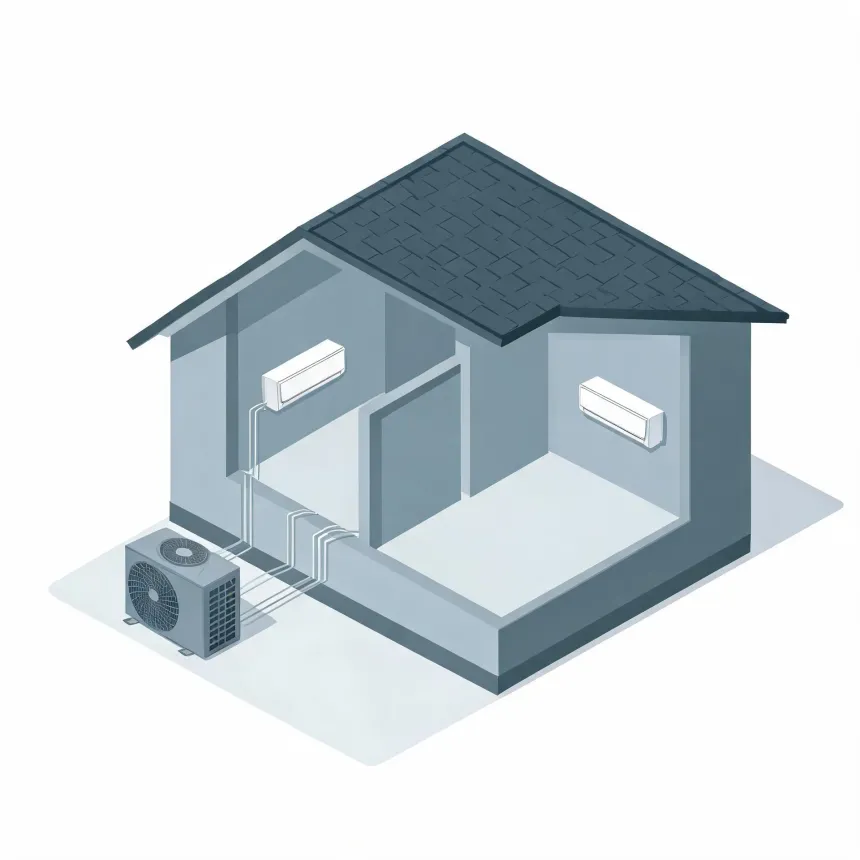
Summerville cools from May through October, six months of the year, and the afternoon high through June, July and August averages 91°F. A mini split sized for this house has to hold that line day after day, not just on the hottest afternoon. An undersized unit runs flat out all summer and still loses ground on the worst days. The right size for this house runs steadier, for longer, through the whole stretch.
Dorchester County is zone 3A, warm with cooling that runs most of the year. Any mini split installed here has to meet 14.3 SEER2 for cooling and 7.5 HSPF2 for heating. That's the federal minimum for split-system heat pumps, and it applies whether the system is ducted or not. A federal tax credit is available for systems that meet it.
Find a contractorSix months of cooling a year means a lot of running hours over the life of the unit. Load calculation at install is what decides whether the system settles into that stretch or strains against it every summer. That's the piece to get right while the install is still being planned, before the compressor's logged a single season.
A mini split can go in alongside a window unit or a struggling central system while that one keeps running. There's no shared ductwork to tie into and no refrigerant lines to match up with what's already there. The old system keeps the house livable until the new one is in and charged, then it's disconnected.
Pulling an old furnace or air handler means dealing with the ductwork it was tied to, and sometimes a gas line if it ran on gas. A mini split replacing one doesn't need any of that removed to go in. What's left is the old equipment itself and whatever line set or disconnect served it, and a licensed contractor handles the refrigerant recovery as part of taking it out.
What drives the cost on a mini split job is mostly the stuff you can't see from the unit itself. How many indoor heads the system needs to cover the space. How far the outdoor unit sits from each one, since every extra foot of line set is more refrigerant line to run, insulate, and seal. Whether that line set can run through an attic or a crawlspace or has to be opened up through finished wall. The electrical work matters too. A dedicated circuit for the outdoor unit is standard, but if the panel is already full, that's its own job before the mini split work even starts. Mounting height and access for the outdoor unit change the labor as well, since a unit set at ground level on a pad goes in differently than one bracketed to a wall or set up on a roof.
Sizing a mini split isn't about matching tonnage to square footage. A contractor works out a load calculation room by room, weighing window area, insulation, ceiling height, and which way each wall faces the sun. Too big and the compressor short cycles, cooling the air fast but shutting off before it pulls the moisture out, so the room feels cold and damp at once. Too small and it never catches up, running flat out without holding the temperature steady. With a multi-zone system, each indoor head gets sized to its own room, not an even split of one total number. The outdoor unit then has to be matched to what all those heads ask for when they're running together, not just added up on paper.