




Two single-story houses, one brick with a covered porch and one with pale siding, seen across a mown lawn and a trimmed hedge, beneath large oak branches draped with Spanish moss.

Mini Split Installation in Sumter, SC

Tell us about the job

Takes about a minute. No obligation.

New system or replacementMini-splitSumter County, SC
Step 1 of 2

What ZIP code is the job in?

The biggest cost driver on a mini split job is how many zones you're running and how far the lines have to travel. A single indoor head cooling one room is a straightforward job. Add a second or third head, and you're adding line sets, more wall penetrations, and another outdoor unit connection, or a bigger outdoor unit built to handle multiple zones. Distance matters too. If the outdoor unit sits far from the indoor heads, the refrigerant lines run longer and the labor to route them cleanly, through walls, up through an attic, along an exterior wall, adds time. Where the condensate drains, how accessible the electrical panel is, and whether the wall you're mounting to is easy to work with all factor in as well. The unit itself is part of it, but the layout of your home is what decides how much work it takes to get it running right.

5 months
November through March, your system heats
5 months
May through September, it cools
36°F
the average winter night it heats against
90°F
the average summer afternoon it cools against
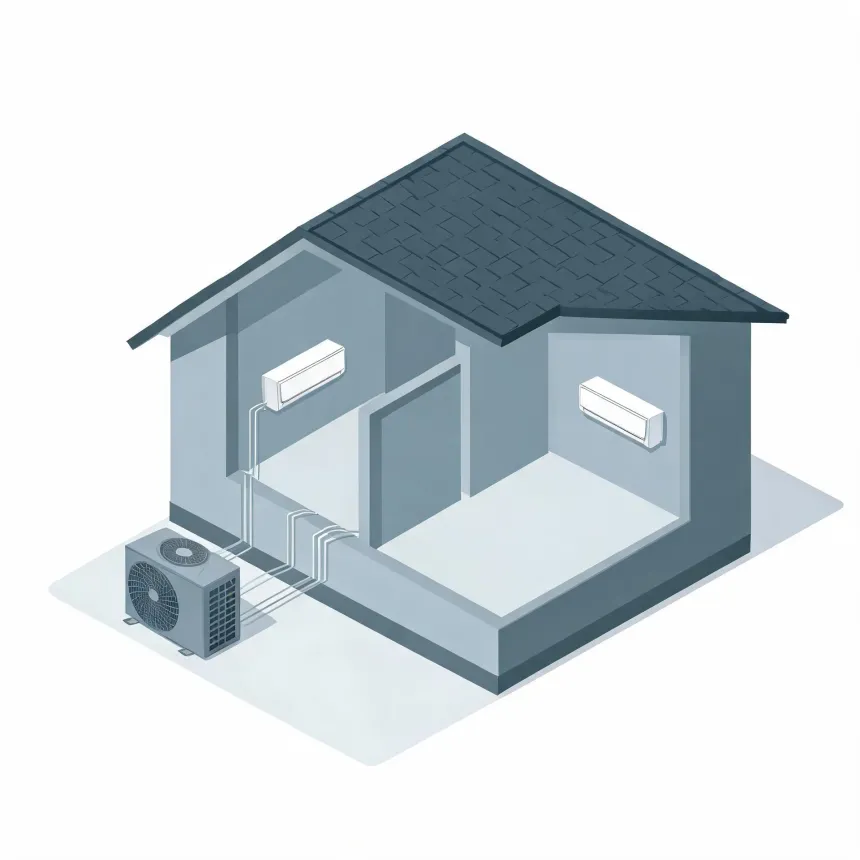
Isometric cutaway illustration of a small house showing two wall-mounted indoor air conditioning units connected by refrigerant lines to an outdoor condenser unit on the ground outside.
Your system heats November through March and cools May through September.

NOAA nClimDiv, 1991–2020 normals

Electricity heats 85.3% of homes in Sumter County.

A mini split works off that same power, so for most homes here it's a straight swap, not a conversion.

Cooling starts in May, so get it installed before then

Cooling runs May through September
Summer afternoons average 90°F
182 damaging wind events from 2015 to 2024
Running a mini split costs more hereSouth Carolina electricity ran 14.23 cents per kilowatthour in 2024.

Sumter sits in climate zone 3A. Warm, with a long stretch of cooling and only a short mild winter. Any mini split installed new here still has to clear the federal minimum for a split-system heat pump. That's 14.3 SEER2 for cooling and 7.5 HSPF2 for heating, whether the system is ducted or ductless. It's a floor, not a target, so it narrows what a contractor can quote but doesn't lock you into one brand or size. Given how much cooling this system will do most of the year, it's worth asking what rating they're proposing above that minimum.

Summers here don't leave room for a mini split that's sized wrong

Five months of cooling, with afternoons averaging 90°F through June, July and August. A mini split sized wrong runs long hours against that heat every summer it's in your home. Get the sizing right the first time.

Find a contractor
A beige split-system air conditioner outdoor condenser unit mounted on metal wall brackets atop a stucco wall.

Ask for the load calculation, not an estimate

Get a load calculation done on the house, room by room, not a guess based on square footage. A contractor who sizes off square footage alone doesn't know how your windows face or where the sun hits in the afternoon. Oversized and the unit short cycles, turning off before it pulls the humidity down. Undersized and it runs flat out all five months without ever catching up. Either way the compressor takes the wear.

Ask what happens when the heat climbs past its rated point

Every heat pump is tested to a certain outdoor temperature, and past that point output drops off. Ask the contractor what backup they're proposing, if any, for the hottest afternoons. Some systems are sized to carry the load alone. Others assume you'll never ask for more than rated capacity, and that's worth understanding before you sign off.
Ask who can service the brand later on

A mini split is only as good as the contractor who can get parts for it down the road. Some manufacturers sell through a narrow dealer network, so if the installing contractor stops carrying that line, finding someone else certified to work on it gets harder. Ask whether the brand is common in the trade locally or something you'd struggle to get serviced years from now.

If this is an install where something's coming out, the old equipment doesn't just get unplugged and left. A window unit or existing ductless head gets disconnected and hauled off. If what's coming out is a central system, the refrigerant in those lines has to be recovered, not vented, that's federal law, and the old refrigerant lines, if they're not being reused, get capped or pulled out. A contractor switching you from ducted to ductless may leave the ductwork in place rather than tear it out, especially if it still feeds other parts of the house. Ask what happens to the old unit and the old lines before the work starts, not after, since removal and disposal is easy to leave out of a quote until it shows up as an add-on later.

Installation day starts with the outdoor unit. It gets mounted on a pad or brackets, leveled, and set where it has clearance on all sides to pull in air. Inside, the mounting plate goes up first, then the indoor head hangs on it once the wall sleeve is drilled through. That's the part that makes the most noise and mess, cutting a clean hole through the wall for the line set, the drain, and the electrical whip to pass through. Once the lines are run and connected at both ends, the system gets evacuated with a vacuum pump to pull out air and moisture before any refrigerant moves through it. Skip that step and moisture sits in the lines, and it'll cause problems months later that are hard to trace back to the install. After the vacuum holds, the system gets charged, tested in both heating and cooling, and checked for airflow at the head and drainage at the condensate line before anyone calls it done.