Why your AC keeps turning on and off in South Carolina
Tell a local repair pro what your air conditioner is doing.
Your AC runs, shuts off after a few minutes, then kicks back on. In South Carolina summer that cycle can repeat all afternoon, and it wears on the parts that start the compressor every time it fires.
A few things cause this. A dirty air filter chokes airflow until the coil freezes and the system shuts down to protect itself. A refrigerant charge that's too low does the same thing from the other direction. An oversized unit cools the room fast, hits the thermostat setting, and shuts off before it has run long enough to pull the humidity out, so the room warms back up and it starts again. A failing capacitor or a thermostat sensor reading wrong can also cause short cycling, and none of these look the same from the outside.
That's the part that matters here. Short cycling has several different causes, and the fix depends on which one it is in your system. Someone who works on AC units around South Carolina all summer has likely seen each of these more than once, knows what tends to go wrong in homes with your kind of setup, and can tell fairly quickly which one is doing it to yours.
When you ask for help through this page, you get matched with one licensed contractor local to you, not a handful of companies competing for your call. They'll reach out to look at your system and work out what's actually causing it to cycle the way it does.
Leave your AC short cycling too long and it's the compressor that pays for it, the most expensive part in the unit to replace. Getting the right person looking at it now is worth more than guessing at it yourself.
Why does my AC keep turning on and off?
You keep noticing the pattern. The AC starts, runs for a few minutes, shuts off, then starts again not long after. It's not cooling the way it should, and you're wondering if something is actually wrong or if this is just how the unit handles the heat. Either way, the on-off cycle has your attention now.
It's short cycling, and it usually means the system is struggling to finish a normal cooling run
A healthy air conditioner runs in long stretches, especially on a hot South Carolina afternoon when the house needs steady cooling for an hour or more. When it shuts off after a few minutes instead, something is cutting that run short. A dirty filter or blocked return can starve the system of airflow until a safety switch trips. A refrigerant leak can do the same thing by freezing the coil. A failing capacitor can stop the compressor from staying on once it starts. Whatever the cause, every restart puts a hard electrical load on the compressor, and a unit that short cycles for weeks is wearing down parts that are expensive to replace compared to the ones causing the problem now.
Normal cycling
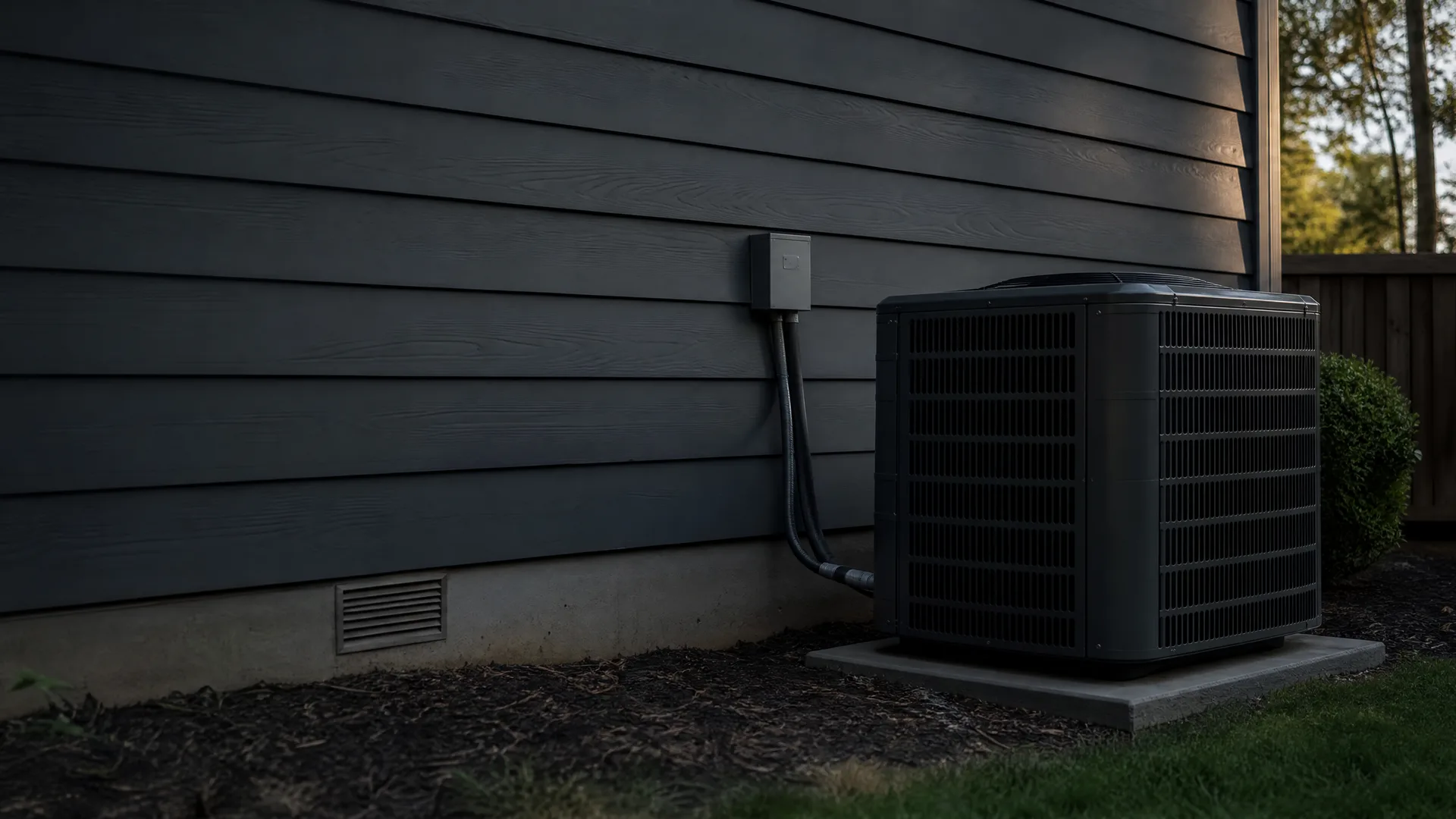
A healthy condenser like this one starts, runs for ten or fifteen minutes, and shuts off once the house reaches temperature. The pad stays clear, the grille stays clean, and the line set runs straight up to the disconnect with nothing blocking airflow around the cabinet.
Short cycling
This unit is working against itself. Leaves and dirt packed around the base and grille restrict the airflow it needs to shed heat, so it shuts off early and restarts again and again. Left alone, that strain falls on the compressor itself.
What this does to your house while it keeps happening
Every time that compressor kicks on and off, it draws the hardest pull of current it ever will. Do that forty times in an afternoon instead of four, and you're asking the capacitor and the contactor to absorb that stress all summer. Those are the parts that usually give out first, and when they do, you lose cooling on a day when the house is already hot. Meanwhile the air inside stays damp, because short runs don't give the system time to actually pull humidity out, so South Carolina summer feels even heavier indoors than it should.
The bill moves too. Starting a compressor costs more than running one, so an AC that short cycles all day burns more power to deliver less cooling, and you feel it before you can point to why. A local contractor who services this equipment every summer can usually place the cause by the pattern you describe and what they find at the unit, and get matched to it rather than guessing their way through a service call.
Your request goes to one pro, not a list of companies.
No fee to send it, and nothing to sign.
What a dirty filter actually blocks
A clogged filter sits between the return duct and the blower, so every bit of air the system moves has to pass through it first. As it fills with dust, less air gets pulled across the evaporator coil. That coil needs steady airflow to stay above freezing. Starve it and the coil temperature drops below 32 degrees, and the moisture in the air around it turns to ice instead of draining away as condensate. Once ice builds on the coil, airflow drops even further, the house stops cooling, and the thermostat cycles the unit off and on trying to catch up. A filter is the one part of this a homeowner can check without a ladder or a meter.
What a failing capacitor looks like
The compressor and the outdoor fan both need a hard push of current to start spinning, and the run capacitor supplies that push. A capacitor that's weakening still has enough charge to start the compressor some of the time, which is why the unit runs for a few minutes before it trips off again rather than failing outright. South Carolina summers put real strain on this part, since a hot afternoon means the compressor is starting and stopping more often than it would in milder weather. A technician checks a capacitor with a meter in a few minutes, reading its capacitance against the number printed on its case.
A short cycle you catch early is a filter swap or a thermostat fix, something a contractor clears in one visit before it touches the compressor.
Let it run for weeks and the hard starts add up, and what began as a filter problem can end with a failed capacitor or a compressor that won't start at all.
Power costs 15.12 cents per kilowatt-hour statewide
At 15.12 cents a kilowatt-hour, a compressor that short cycles all afternoon costs you more than one that runs its normal ten or fifteen minutes and shuts off. Every hard start pulls extra current, and that pull shows up on the bill before it shows up as a failed part.
EIA-861 2025 statewide residential average
Running as it should
This unit cycles the way it's meant to. Conduit runs clean from the disconnect down the siding, the pad is clear, and nothing around it blocks airflow. It starts, cools the house, and shuts off on its own schedule, not because something tripped it.
Cycling too often
Same setup, same wall, but this one is firing on and off far more than it should. Nothing about the outside tells you if it's the filter, the thermostat, or a part inside the unit. A contractor who works on these year round in South Carolina can look at it and tell you which.
Short cycling has a cause, and it's one a contractor can find by looking at the filter, the thermostat, the charge, and the parts that take the hit every time the compressor restarts. A system that starts and stops every few minutes all summer isn't going to fix itself, and the longer it runs that way, the more it costs to put right. A contractor who works on AC units across South Carolina all summer has seen this pattern often, in houses with every kind of setup, and knows where to look first. You'll be matched with one licensed contractor local to you, not a handful of companies competing for the job, so the person who calls you back is the one who'll actually show up and do the work. Your AC can run the way it's supposed to, cooling the house and shutting off on its own schedule. Getting there starts with someone qualified taking a look.
Matched to your air conditioner job
The pro who reaches out is licensed in South Carolina.