Profile view of a bearded man wearing a dark baseball cap and a dark gray T-shirt against a plain off-white background.

AC leaking water inside in muggy South Carolina summers

RepairCentral ACSouth Carolina
Step 1 of 2

What ZIP code is the job in?

Why is my AC leaking water inside my house?

Water showing up around your indoor unit or dripping from a vent is unsettling, especially when you're trying to keep the house comfortable through a South Carolina summer. You want to know if this is something to watch or something to stop right now, and what's actually sending that water into your house instead of outside where it belongs.

A clogged drain line is the usual cause

Your AC pulls a lot of moisture out of the air before it ever cools it, and that water is supposed to run out through a drain line to the outside. In the thick humidity South Carolina summers bring, that line fills faster and clogs more often with algae and dirt, and once it's blocked the water backs up and finds its way out through the unit instead, usually at the indoor coil or the pan underneath it. A frozen coil that thaws out fast can do the same thing, dumping more water than the drain or pan can handle. Either way, the water isn't dripping from nowhere. It's being pushed into your house because it can't get out the way it's supposed to.

An outdoor air conditioner condenser unit beside a light-colored lap-sided house with an electrical disconnect box on the wall, surrounded by shrubs and lawn in low evening light.

You're out back around seven, grass still warm underfoot, watching the sky go orange over the fence line. The condenser sits by the hose bib, humming the way it always does, except the fan isn't turning. You crouch down and listen closer. Just the compressor, no air moving over the coil. Inside, you remember the carpet was damp near the hallway vent when you left for work this morning and you figured it would dry out on its own. It didn't. Now you're standing in the yard doing the math on how long the unit's been running like this, coil likely icing over, line probably sweating until it can't hold any more and drips wherever gravity takes it.


Clogged Line or Frozen Coil

Clogged drain line

  • The condensate line runs outside and sits damp most of the summer, which lets algae build up inside it until water backs up and finds another way out.
  • Water usually shows up at the drain pan or pools under the indoor unit itself, not far from where the line connects.
  • A contractor can often clear it with a wet vac or compressed air in one visit.
  • If it backs up again within a season, the line may have a low spot or a kink somewhere along its run.
  • This is the more common reason for leaking in homes running the AC hard through a Carolina summer.

Frozen coil thawing out

  • A coil freezes when airflow is restricted or refrigerant is low, then it thaws and sheds more water than the drain pan is built to catch.
  • You may notice the air from the vents feels warmer than usual before you ever see water.
  • A dirty filter is often behind the frozen coil, since it blocks the air the coil needs to stay above freezing.
  • A refrigerant leak can cause the same freezing, and that needs a licensed contractor to find and fix.
  • If this keeps happening, running the system without addressing the cause can put more strain on the compressor.
A gray outdoor air conditioner condenser unit on a concrete pad beside a house with horizontal lap siding, with a wall-mounted disconnect box and conduit, mulch bed, shrub, and lawn nearby.

Running the way it should

A condenser humming along on its pad, lines running clean up the wall to the disconnect box, means the condensate is draining the way it's built to. No water at the pad, no water inside. The mulch and grass around it stay dry.

An outdoor air conditioner condenser unit sits on a gray pad beside a light vinyl-sided wall, on a concrete slab next to a gravel bed.

Signs something's backing up

Look at the ground around the pad and along the conduit. Water pooling there, or a damp line where it shouldn't be, often points back to a clog or a pan that's overflowing, and it's worth checking what's happening inside before it shows up on your floor or ceiling.

A woman with long blonde hair in a light blue shirt leans back on a beige sofa with her eyes closed, in a softly lit living room with cushions and a blurred plant and shelf in the background.
A woman with long dark hair in a gray knit sweater sits on a gray sofa with a cushion, looking toward a window in a living room with framed pictures and a lamp in the background.
A woman with long dark hair in a light grey knit sweater sits on a sofa indoors, looking to her right, with a framed landscape picture, a potted plant and a curtained window behind her.
A woman with long dark hair leans back against a gray sofa with her eyes closed, in a living room with a curtained window, a potted plant, and a dark screen in the background.

Get the right pro for your air conditioner

A clogged drain line or a cracked pan is a common repair, but the fix still depends on getting to the right part fast, before the water reaches the subfloor or the ceiling below it. South Carolina summers keep that line wet for months at a stretch, which is exactly the condition that lets algae take hold in the first place. A contractor who works on AC systems here through July and August has seen that line clog more times than they can count, and knows where water tends to back up and what usually causes it. Getting matched sends your request to one licensed contractor local to you, someone who services this kind of leak regularly rather than a handful of companies competing for the job. That water isn't going to stop finding its way out on its own, and the sooner someone who knows this equipment takes a look, the less it costs you in damage waiting it out.

An outdoor air conditioner condenser unit on a concrete pad beside a house wall, with a gray electrical disconnect box and conduit above it and grass in the foreground.

Why the pan fills first

Your indoor unit sits over a drain pan built to catch exactly this kind of overflow. When the condensate line clogs, water backs up into that pan before it goes anywhere else. A small pan fills fast once the line stops draining. Some units have a float switch that shuts the system off when the pan gets too full, which stops the leak but also stops your cooling. If yours keeps running anyway, the water has somewhere else to go, usually down through the cabinet and onto the floor below.

A gray outdoor air conditioner condenser unit on a concrete pad beside a house with horizontal lap siding, surrounded by white gravel and a lawn, with a white wall at left.

What the humidity adds

A South Carolina summer pulls a lot of moisture out of the air inside your house, and that moisture has to go somewhere. All of it passes through the same drain line as condensation from the coil. More humidity means more water moving through that line every day it runs. A line that might clog once a season somewhere drier can clog twice as fast here, because there's simply more water working through it on a July afternoon than a dry Colorado one.

Power costs 15.12 cents per kilowatt-hour statewide

A clogged line doesn't just mean cleanup. Left alone, that water running costs you at 15.12 cents a kilowatt-hour adds up fast once a technician has to dry out and repair whatever it soaked, on top of the AC itself working harder to keep the house comfortable while it's not draining right.

EIA-861 2025 statewide residential average

Catch it early

A damp spot on the carpet near the indoor unit, or a faint musty smell in the hallway closet where the air handler sits, means the drain line or pan is already overflowing. Caught at this stage, a technician clears the line or seals the pan before anything below it takes damage. The AC keeps running, the house stays dry, and the repair is contained to that one part. This is the easiest version of this problem to deal with, and it's also the one most people miss because the water hasn't reached anywhere obvious yet. Checking the closet or the ceiling below the attic unit once a month through the summer is what catches it here.

Wait, and it spreads

Leave that same clog alone and the water doesn't stop at the pan. It finds the ceiling drywall below an attic unit, or the subfloor under a closet unit, and soaks in before anyone notices a drip. By the time a stain shows up overhead or the floor feels soft underfoot, the fix isn't just the drain line anymore. It's drywall, insulation, maybe flooring, on top of whatever caused the backup in the first place. The AC itself may shut off on a float switch once the pan is full, leaving the house without cooling in the middle of a South Carolina summer until someone gets to both the clog and the damage it left behind.

An outdoor air conditioning condenser unit on a concrete pad beside a house with horizontal lap siding, with a shrub and mulch bed to the left and conduit and a small electrical box on the wall to the right.
Before you get your air conditioner repair
A gray outdoor air conditioner condenser unit sits on a concrete pad beside a house with horizontal lap siding, with conduit and an electrical disconnect box on the wall, dark mulch and a shrub to the left, and a concrete walkway in the foreground.
After you get your air conditioner repair
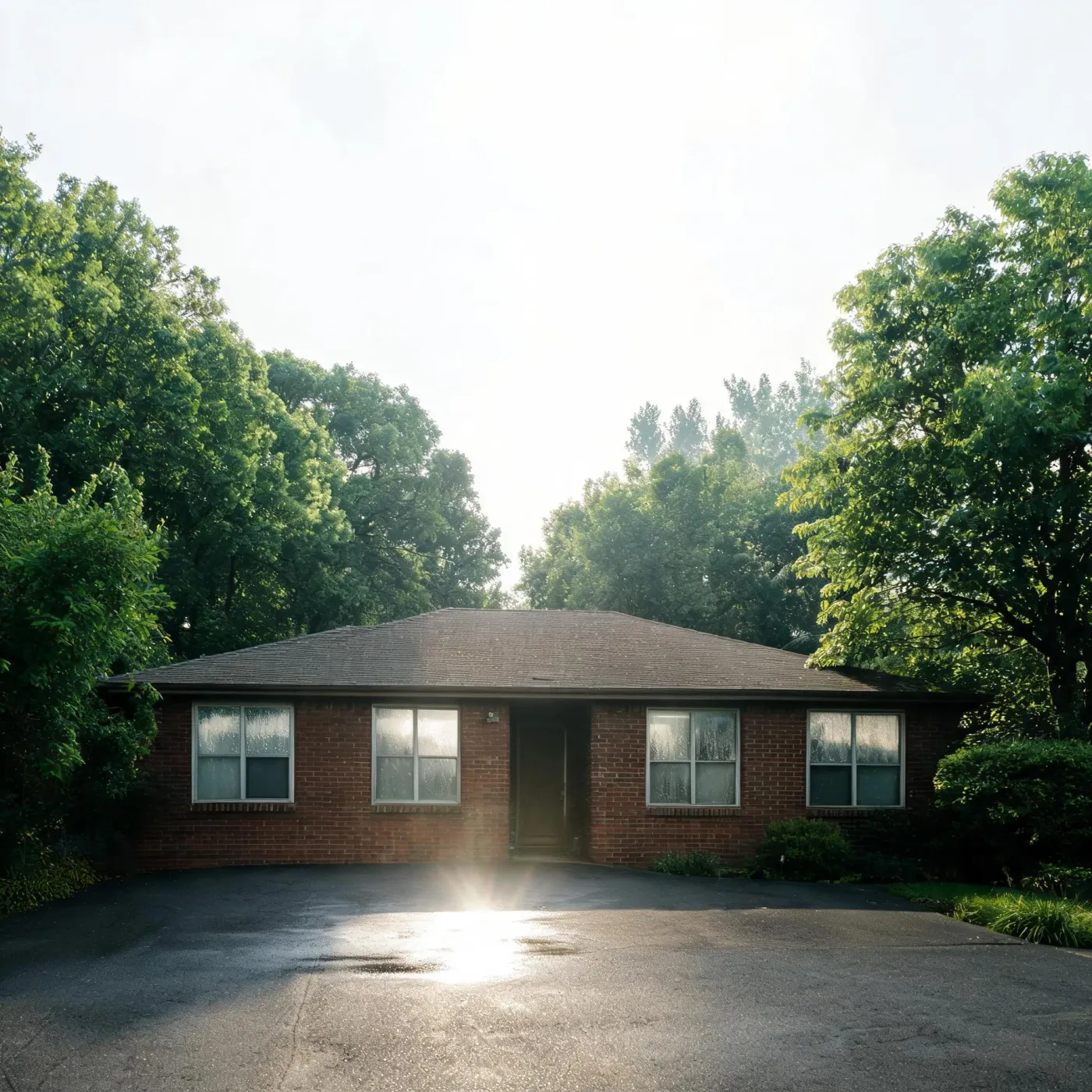
A single-story red brick house with a dark shingled hip roof, central door and four windows, fronted by a wide asphalt driveway and flanked by leafy green trees under a bright hazy sky.

South Carolina summers hold a dew point around 69°F on average across June, July and August, according to NOAA climate data. That's heavy, sticky air, the kind that makes a shirt stick to your back just walking to the mailbox. Your air conditioner has to pull a lot of that moisture out of the house to keep things comfortable, and all that water has to go somewhere. It runs down the condensate line, every hour, all summer long. A line that only had to handle an occasional light load in a drier climate is instead working constantly, which gives algae and sludge more chances to build up and clog it. That's a big part of why drain lines back up so often here.

NASA POWER T2MDEW county cells weighted by homes

Water inside the house almost always comes down to a clogged drain line or a cracked pan, and both are things a technician can find fast once they're standing in front of your unit. The humidity here keeps that line wet all summer, which is exactly why it clogs in the first place, and why it's worth getting checked instead of mopped up and ignored. The contractor who calls you back works on this equipment all season long, in homes with the same mugginess and the same drain lines, so they know where water collects and what usually fails first. You'll hear from one local, licensed contractor, not a string of calls from companies that don't know your address or your system. That means someone looking at your actual unit, not a general guess about what it might be.

A house roofline with a stone chimney rises above trees, with a tall pine, Spanish-moss-draped oak branches, and misty hills in the background.

A pro who works on air conditioners

Get an air conditioner pro

You're not committing to anything by asking.

A clogged drain line rarely clears itself, and every muggy week that passes gives it more water to push back into the pan. Getting a local contractor out before it overflows again is the easier fix, for the floor underneath and for the unit itself.