






Two single-story houses, one brick with a covered porch and one with pale siding, seen across a mown lawn and a trimmed hedge, beneath large oak branches draped with Spanish moss.

Heat Pump Repair in Edgefield, SC

Tell us about the job

Takes about a minute. No obligation.

RepairHeat PumpEdgefield County, SC
Step 1 of 2

What ZIP code is the job in?

A heat pump needing a repair now and then is normal. What matters more is the pattern. A failed capacitor or a bad contactor is a part that fails on its own, no matter how old the rest of the unit is. Replacing just that part is usually the right call. A compressor struggling to start, or a reversing valve that won't switch between heating and cooling, points to something different. Those point to a system that's wearing out rather than a one-time failure. The compressor is the one to watch closest. It's the most expensive part in the system and the hardest to justify replacing on its own. If a contractor tells you the compressor is failing, that's the point to ask whether putting more money into this unit still makes sense.

5 months
November through March, your system heats
5 months
May through September, it cools
36°F
the average winter night it heats against
91°F
the average summer afternoon it cools against
Isometric line illustration of a cutaway house showing interior rooms with furniture, ceiling ductwork under a dark shingled roof, and an outdoor condenser unit connected by lines on the right.
Your system heats November through March and cools May through September.

NOAA nClimDiv, 1991–2020 normals

A heat pump that's low on refrigerant will keep running, just worse.

The compressor still fires up and runs hot and dry until it wears itself out.

November and May are when a weak part gives out

Cooling runs May through September
Heat runs November through March
Power costs 14.23 cents a kWh statewide
Half the homes here were built in 1988 or earlierMobile homes make up 24.7% of the housing stock in Edgefield County

Edgefield County has had 99 severe weather events between 2015 and 2024, most of them damaging wind, with hail and a few tornadoes mixed in. An outdoor unit sits outside year-round, so it takes that weather directly. Hail can dent the fins or bend them flat against the coil, and a unit can keep running for weeks after that before it loses efficiency or fails outright. Wind-blown debris does similar damage, often out of sight on the back or underside of the cabinet. If your unit went through a storm recently and you haven't had it looked at, that's worth doing even though it still runs.

Get it looked at early

Problems tend to show up in the first weeks of the season, when the load hits a part that was already weak.

Find a contractor
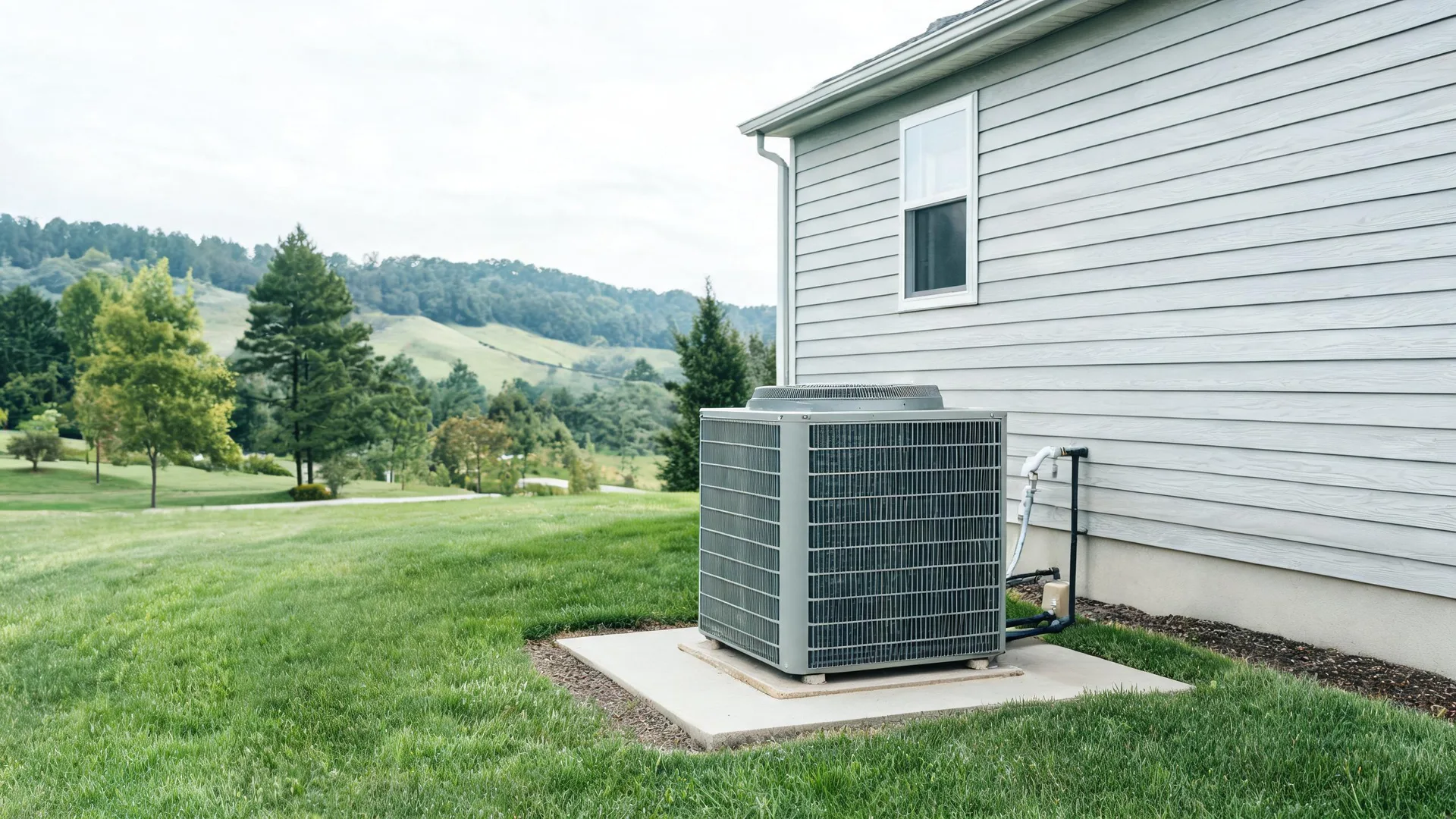
A gray outdoor HVAC unit mounted on a concrete pad beside a house with gray lap siding and a stone foundation.

The parts that never get a break are the ones that wear out

A heat pump runs the whole year, so the parts that wear are the ones that never get a break. The outdoor fan motor turns the entire time the system is heating or cooling, and the bearings in it eventually dry out or seize. You'll hear it before it quits, a grinding or rattling sound from the outdoor unit. The run capacitor that kicks the compressor and fan motor into motion loses its charge over years of cycling on and off, and when it goes weak the unit struggles to start or the fan turns slower than it should. The reversing valve, the part that switches the system between heating and cooling, can stick in one position after years of use, especially if it doesn't get exercised in both directions regularly. Contactors pit and burn from the arcing every time they close, until one day they don't make contact at all. None of these fail because of one bad day. They fail because the system never stops asking something of them.

What you'll notice first

Air coming from the vents that's cooler than usual during heating mode. A system that runs long stretches without shutting off, or one that short cycles every few minutes instead. Ice on the outdoor unit during a heating cycle is normal in small amounts, but a heavy coat that doesn't clear during defrost means the reversing valve or the defrost control isn't doing its job.
Why a small problem doesn't stay small

A heat pump that's struggling still runs, which is why people put off calling. A weak capacitor makes the compressor strain every time it starts, and a compressor that strains on startup wears faster than one that starts clean. What would have been a simple part swap turns into a compressor failure instead.

Before you call anyone, check the thermostat batteries and the setting itself. A thermostat set to cool when you meant heat, or a dead battery that's dropped the display, looks exactly like a system failure from across the room. Next, go to the breaker box. A heat pump that won't start at all is sometimes just a tripped breaker, and it's safe to reset it once and see if it holds. Outside, look at the unit itself. Clear away leaves, grass clippings or anything stacked against the sides, since the outdoor unit needs open airflow on all sides to work at all. Check the air filter too. A filter clogged with dust chokes the airflow across the indoor coil, and that alone can cause weak heating or short cycling that looks like a bigger problem than it is. If the breaker trips a second time after you reset it, stop and call someone. That's the system telling you something's actually wrong.

A diagnostic visit starts outside at the unit, checking the pressures on the refrigerant lines and the amp draw on the compressor and fan motor while the system runs. Those readings alone rule out or confirm most of what causes a complaint. Inside, the tech checks the temperature of the air coming off the coil against what's expected for the mode it's running in, which tells them whether the system is actually moving heat the way it should. The electrical side gets checked too, the contactor, the capacitor, the wiring at the connections where heat and vibration loosen things over time. If the system has a fault history stored in its control board, that gets pulled and read before anything else, since it often points straight at what failed. None of this takes long once someone's standing in front of the unit. The part that takes time is explaining what they found and what it means for the one you have.