





Single-story brick and cream-sided houses with covered porches behind a trimmed hedge and lawn, shaded by large oak trees draped with Spanish moss under an overcast sky.

Heat Pump Repair in Gaffney, SC

Tell us about the job

Takes about a minute. No obligation.

RepairHeat PumpCherokee County, SC
Step 1 of 2

What ZIP code is the job in?

A heat pump that's struggling will often keep trying anyway, and that's where the real damage starts. A low refrigerant charge makes the compressor work harder to move heat, and it can overheat from the strain. Ice on the outdoor coil blocks airflow, so the system pulls in less and less warmth while it keeps drawing power. A failing contactor or capacitor can leave the compressor trying to start without fully starting, which wears the motor windings down fast. None of this fixes itself by running longer. The longer a struggling unit stays on, the more likely a repair turns into a compressor replacement.

7 months
October through April, your system heats
5 months
May through September, it cools
32°F
the average winter night it heats against
88°F
the average summer afternoon it cools against
Isometric illustration of a cutaway single-story house showing interior ductwork and vents connected to an outdoor condenser unit beside the building, on a white background.
Your system heats October through April and cools May through September.

NOAA nClimDiv, 1991–2020 normals

Cherokee County homes split close to evenly, built before 1984 or after, and neither side explains a heat pump acting up.

A Gaffney heat pump acting up is almost always one of a few things. Low charge, a bad capacitor, a frozen coil. A contractor can usually spot it on the first visit.

Cherokee County runs its heat pumps nearly year round, October through April and May through September

Cooling runs May through September
Heat runs October through April
Climate zone 3A

Before anyone comes out, there are a few things worth checking yourself. Look at the outdoor unit first. If the coil is caked in ice or the fan is covered in leaves and debris, that alone can choke the whole system. Check the thermostat is set to heat, not just on, and that the temperature is actually set above room temperature. Walk around the house and check that supply vents aren't closed or blocked by furniture, since a heat pump needs airflow moving to work right. Check the breaker panel too. A tripped breaker on either the outdoor unit or the air handler will stop the system cold, and if it trips again after you reset it, that's a sign to stop and call someone rather than keep resetting it.

Get the usual fix

Nothing about this area is especially hard on it. It's most likely the usual problem with the usual fix.

Find a contractor
A man in a worn dark jacket and tan pants, seen from behind, climbs porch steps toward a dark green paneled front door while carrying a canvas tool bag holding a hammer and other tools, with a potted conifer shrub to the right.
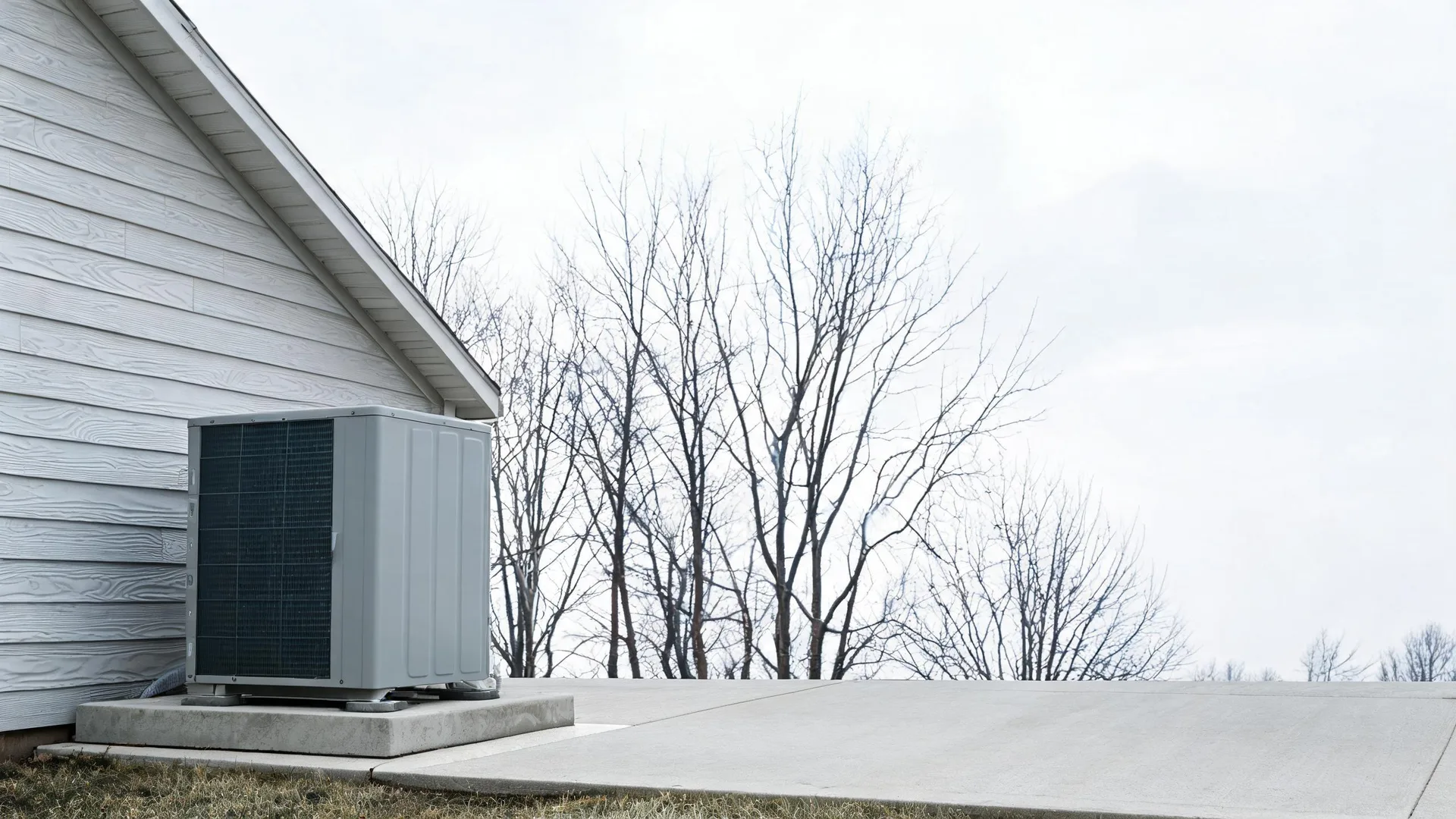
A gray outdoor HVAC unit mounted on a concrete pad beside a house with gray lap siding and a stone foundation.

Long hours, not hard ones, so repair is usually the right call

The heat pump here runs close to year round, but it's rarely working hard. Winters are short and mild, so it isn't fighting single-digit cold like units further north. Summers are long and humid, but the heat doesn't push into extremes either. That's long hours without heavy strain, which is an easier life than most climates give this kind of system. Wind and hail are the bigger threat in this county, not the workload. So when one here is acting up, it's rarely the machine finally giving out. More often it's a part that failed or got knocked loose, and that's usually worth fixing.

Most failures start outside

The outdoor unit takes the weather, so it's usually where trouble starts. The fan motor bearings wear out from running in all conditions. The reversing valve can stick from corrosion or just age, leaving the system stuck heating when it should cool or the other way around. Dirt and grass clippings pack into the coil fins over seasons of being outside, and that slow buildup chokes airflow long before anyone notices the system working harder than it should.
What that means for the fix

A stuck reversing valve or a dying fan motor is a straightforward swap, not a sign the whole unit is done. The coil can usually be cleaned rather than replaced, and that alone often brings a struggling system back to normal. The part that matters is catching it early, since a fan motor that's starting to fail will keep running weaker until it stops, and a system pulling air through a dirty coil puts the same load on the compressor as a low charge would.

Most people notice a heat pump problem through comfort before anything else. The air coming out of the vents feels cool or lukewarm when it should feel warm, or the system runs long stretches without the house actually catching up to the thermostat. Some will hear it first instead, a clicking at the outdoor unit that doesn't resolve into the compressor starting, or a hum that trails off instead. Ice on the outdoor coil during the heating months is never normal and worth a look right away. A system that short cycles, switching on and off every few minutes instead of running a full cycle, is usually struggling with either airflow or charge. Any of these is worth a call before the compressor ends up paying for it.

A diagnostic visit starts outside at the unit itself, checking refrigerant pressures, electrical readings at the contactor and capacitor, and how the fan and compressor are actually running under load rather than just whether they turn on. From there it moves to the reversing valve, checking it actually switches between heating and cooling instead of sticking partway. Airflow gets checked too, since a coil choked with ice or dirt looks like a refrigerant problem until someone actually measures it. Inside, the thermostat and the air handler get checked together, since a heat pump acting up outside can just as easily be a signal problem from inside the house. Most of this takes one visit. The findings usually point to one part, not a list of them, and that's what gets fixed first before anything else is touched.