







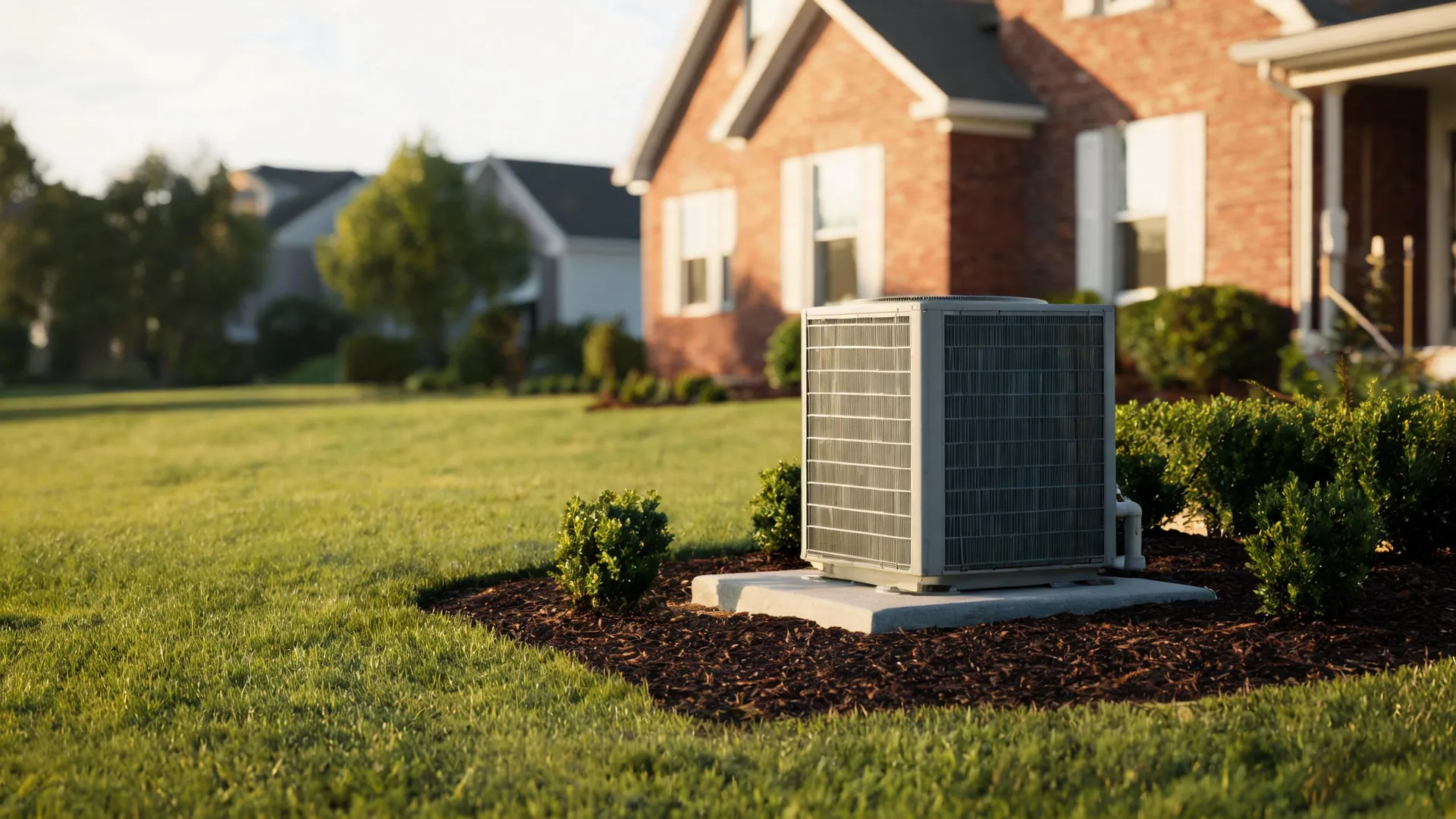
An outdoor air conditioning condenser unit mounted on a concrete pad in front of a single-story suburban house.

Heat Pump Repair in Hilton Head Island, SC

Tell us about the job

Takes about a minute. No obligation.

RepairHeat PumpBeaufort County, SC
Step 1 of 2

What ZIP code is the job in?

A heat pump that's struggling still runs, and that's what causes the damage. Low refrigerant makes the compressor work harder to move heat that isn't there, and it can overheat. Ice building up on the outdoor coil blocks airflow, so the system pulls in less and less heat each cycle while still drawing full power. A failing contactor arcs a little more each time it closes, until it welds shut or burns through. None of these get better by waiting, they get worse the longer the system keeps cycling. The compressor is usually the last part to fail, after everything around it has already been struggling to make up for whatever started the problem. A strange sound, weak airflow, or ice where there shouldn't be any is the system telling you something upstream is wrong before the compressor pays for it.

5 months
November through March, your system heats
6 months
May through October, it cools
42°F
the average winter night it heats against
89°F
the average summer afternoon it cools against
Isometric line illustration of a cutaway single-story house showing interior ductwork, an indoor air handler unit, and an outdoor condenser connected by refrigerant lines, with a dark shingled roof.
Your system heats November through March and cools May through October.

NOAA nClimDiv, 1991–2020 normals

Heat pumps here switch over and start heating in November.

October is the month to get a struggling one looked at, before the first cold snap finds the weak part.

Half the homes here were built since 1999, so the heat pump age works in your favor

Half the homes here were built by 1999
304 damaging wind events from 2015 to 2024
Power costs 14.23 cents a kWh statewide
Storms here put a heat pump through a lotBeaufort County took 304 damaging wind events between 2015 and 2024

Beaufort County saw 371 severe weather events between 2015 and 2024, most of them damaging wind. The outdoor unit sits outside with no cover from any of it. Wind-driven debris can bend the fins on the coil or crack a fan blade without stopping the unit from running. Hail can dent the cabinet or damage the coil underneath it the same way. A heat pump that took a hit like that can keep working for weeks before the refrigerant charge drops low enough to notice, or the airflow loss catches up with it. If the outdoor unit sat through a storm this year, it's worth having someone look at what the hail or wind actually did to it.

Get it looked at early

Problems tend to show up in the first weeks of the season, when the load hits a part that was already weak.

Find a contractor
A man in a cap, dark long-sleeve shirt and brown work pants, seen from behind, steps up onto a porch toward a dark green door while carrying a canvas tool bag.
A residential heat pump outdoor unit mounted on a concrete pad next to a house with gray vinyl siding.

This heat pump has had fewer years to wear out

If your heat pump came with a newer house, it has had fewer years to wear out. A compressor or control board failure on a unit like that is usually one bad part, not a system giving out all at once. That is worth asking the contractor straight. Is this a repair, or is the unit old enough that this is the start of a pattern.

What you can check safely

Look at the outdoor unit and clear anything piled against it, leaves, grass clippings, a fallen branch. Check the air filter and swap it if it's gray with dust. Walk the vents inside and make sure none are closed or blocked by furniture. Check the thermostat batteries and make sure it's set to heat, not cool. Look at the breaker panel and reset any breaker that's tripped, but if it trips again, leave it alone.
What to leave for a contractor

Anything involving the refrigerant lines, the coils, or the inside of the cabinet is not a homeowner job. If you see ice on the outdoor unit, frost on the lines, or hear grinding or buzzing from inside the cabinet, turn the system off at the thermostat and leave the panels closed. Opening the unit or pouring water on ice to melt it faster can damage a part that was otherwise fine.

A reversing valve that's starting to stick won't always fail outright, it just stops switching clean, so the system blows cool air when it should be heating. Capacitors weaken with age and heat cycles, and a weak one makes the compressor or fan motor strain to start, which shortens what's left of its life. Dirty outdoor coils force the whole system to run longer to move the same amount of heat, and that extra runtime is what wears out motors and bearings early. A low refrigerant charge almost always means a leak somewhere in the lines or coil, not the refrigerant being used up, since a closed system doesn't lose it on its own. Control boards fail from age, from moisture getting into the cabinet, or from a power surge, and once one goes the system can stop responding to the thermostat entirely.

A contractor weighing repair against replacement is really asking how many more parts are likely to go. One failed capacitor on a unit that's otherwise sound is an easy call, you fix it and move on. A compressor failure is a different conversation, since the compressor usually goes last, after other parts have been straining to cover for it. If a contractor finds the compressor is the problem, it's worth asking what else was already weak before that happened. Age matters less than pattern. A unit that's needed a string of unrelated repairs is telling you something different than one that's run clean for years and hit a single bad part.