April is worth a look
Cooling starts in May here. A capacitor or charge that was already weak tends to give out once the heat pump has to run hard in the first warm week, so April is when a check still catches it.
Takes about a minute. No obligation.
Cooling starts in May here. A capacitor or charge that was already weak tends to give out once the heat pump has to run hard in the first warm week, so April is when a check still catches it.
Heat runs November through March in Williamsburg County. Whatever gave the system trouble this summer is still there in October, and it will show up again the first cold night unless someone looks at it first.
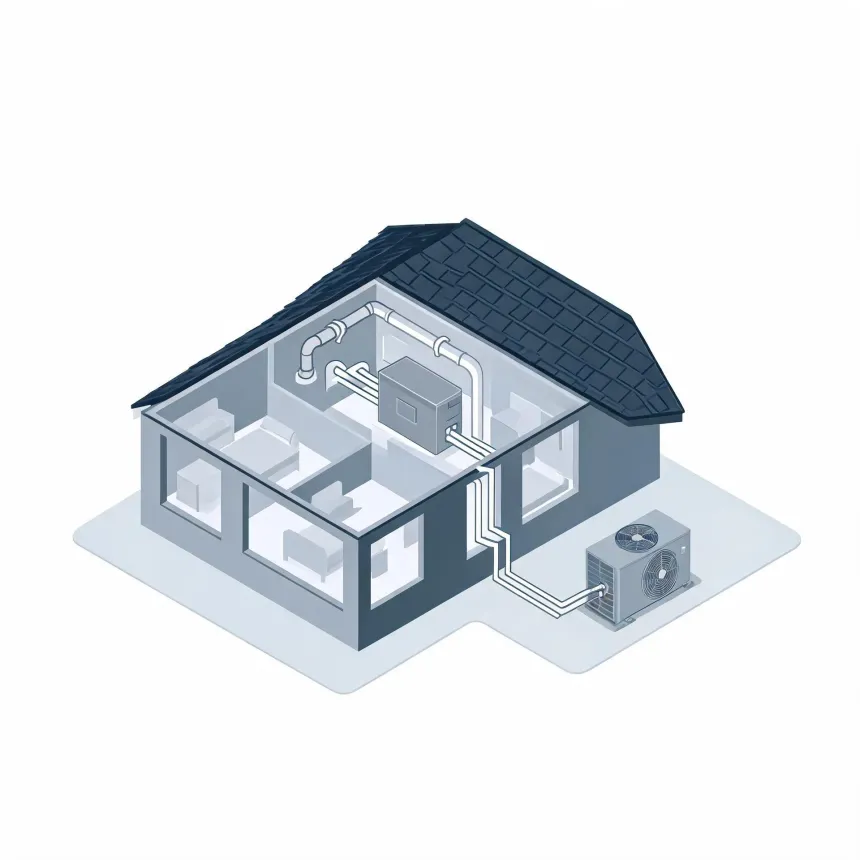
NOAA nClimDiv, 1991–2020 normals
A heat pump that is low on refrigerant will keep running, but the compressor works harder to move the heat it has, and that extra strain is what burns it out.
Shut it off and get it looked at before the next cycle, because a compressor is the one part that usually can't be replaced on its own.



Williamsburg County recorded 47 severe weather events between 2015 and 2024, most of it wind. That's not nothing, but it's not what usually takes down a heat pump either. Power blinks off during a storm, and the unit comes back on its own once it's restored. What actually fails is what fails anywhere. A capacitor gives out, the charge runs low, a contactor sticks. Start with that before you start wondering about a storm from months back.
Problems tend to show up in the first weeks of the season, when the load hits a part that was already weak.
Find a contractorBefore anyone comes out, check a few things yourself. Look at the outdoor unit. If the coil is packed with leaves or grass clippings, or a fence line is blocking airflow, clear it and see if that alone helps. Check the air filter inside. A clogged filter starves the system and can make a heat pump freeze up on one side. Look at the thermostat. Make sure it's set to heat or cool as you intend, and swap the batteries if it uses them. Check your breaker panel for anything tripped. If the outdoor unit is running but caked in ice outside of a normal defrost cycle, that's worth noting for whoever comes out, not something to chip off yourself. None of this fixes a bad capacitor or a low charge, but it rules out the easy stuff first.
A heat pump has one part a straight AC doesn't have. The reversing valve is what lets it switch between heating and cooling. When it sticks, the system can get stuck in one mode. Sometimes it runs fine but blows air that isn't the temperature you asked for. That's a heat pump problem. It doesn't show up on a furnace or an AC-only system.
Past the reversing valve, a heat pump fails the way any compressor-driven system does. A capacitor weakens and stops giving the compressor or fan motor the jolt it needs to start. A contactor pits and sticks so the outdoor unit won't come on. The charge runs low from a slow leak, and the compressor works harder to make up for it. The defrost control fails to kick the system into defrost, and ice builds up on the outdoor coil until airflow stops altogether.
Most of the time the signs show up before the system quits outright. Heat that feels lukewarm instead of warm, in heating mode, often means the reversing valve isn't fully switching, not that the unit is failing completely. A hissing or bubbling sound near the lines can mean the charge is low. Ice on the outdoor coil that doesn't clear during a normal defrost cycle means the defrost control or a sensor has stopped doing its job. Short cycling, where the unit kicks on and off every few minutes instead of running a full cycle, usually points to a weak capacitor or a clogged filter choking airflow. Any of these is worth a call before the part it's straining finally gives out.
A repair makes sense when one part has failed and the rest of the system is sound. A capacitor, a contactor, a defrost sensor, these are inexpensive to replace and swapping one doesn't tell you anything about the compressor or the coils. Replacement starts to make sense when the compressor itself is the problem, because that's the part that usually can't be swapped out on its own, and a system can't heat or cool without it. Age matters less than what's actually failing. A unit that's been well kept can still be worth repairing after many years, while a newer one that's been run low on charge for a long stretch may have already strained the compressor more than the age suggests. If someone's telling you to replace the whole system over a bad capacitor, get a second opinion before you agree to it.