A brick house with a white porch and a light-colored single-story house behind a trimmed hedge, framed by large oak branches draped with Spanish moss.

Heat Pump Repair in Myrtle Beach, SC

Tell us about the job

Takes about a minute. No obligation.

RepairHeat PumpHorry County, SC
Step 1 of 2

What ZIP code is the job in?

Warm air in heating mode, weak airflow, or ice on the outdoor unit

A heat pump blowing air that feels cool instead of warm often means the reversing valve is stuck or the refrigerant charge is low. Ice building up on the outdoor coil when it shouldn't, or the unit running nonstop without catching up to the thermostat, points to the same kind of trouble. Short cycling, where it kicks on and off in quick bursts, usually means a failing sensor or a compressor under strain.

Catching it early keeps a repair from becoming a replacement

A compressor that runs low on refrigerant for too long can seize, and that turns a simple recharge into a full system swap. Ice left on the outdoor coil blocks airflow the whole unit depends on, so the longer it sits the harder the compressor works. The sooner a tech sees the unit acting up, the more likely the fix stays small.

5 months
November through March, your system heats
5 months
May through September, it cools
37°F
the average winter night it heats against
89°F
the average summer afternoon it cools against
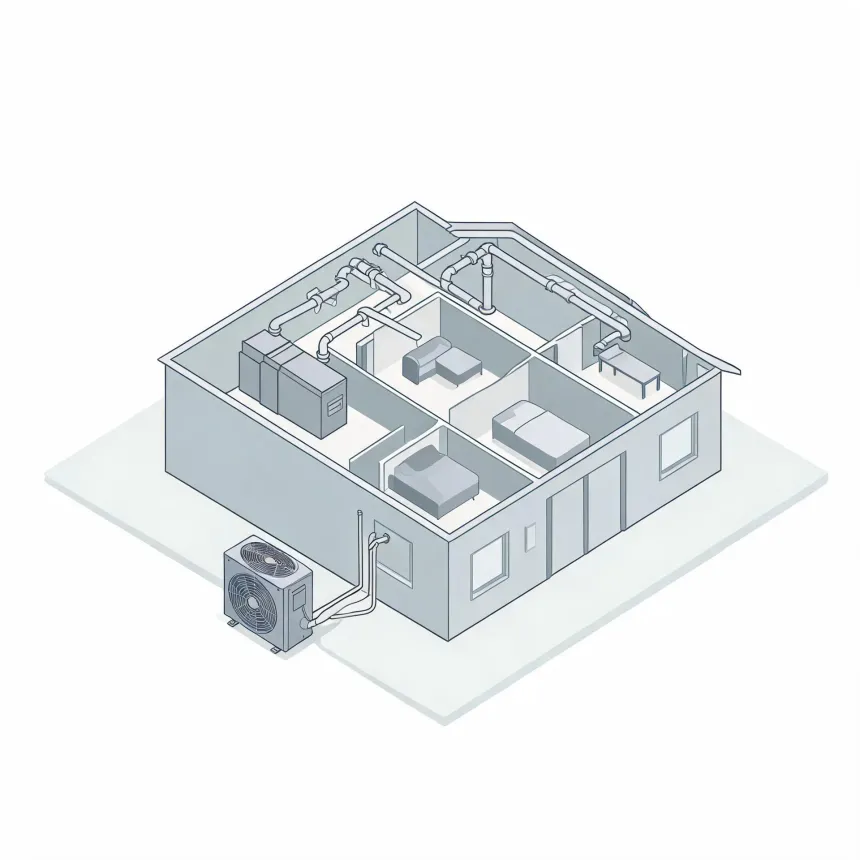
Isometric line illustration of a cutaway single-story house showing interior rooms with beds and furniture, ceiling ductwork connected to an indoor air handler, and an outdoor condenser unit linked by refrigerant lines.
Your system heats November through March and cools May through September.

NOAA nClimDiv, 1991–2020 normals

Half the homes in Horry County were built in 1999 or later.

A heat pump installed with a newer house usually still has years of service left in it, which makes repair the right first call.

October is worth a look before the heat kicks on in November. A heat pump that has been sitting in cooling mode for months is about to get asked to do something different, and a part that was already borderline tends to show it then. A reversing valve that sticks won't announce itself until the first real call for heat. Ice on the outdoor coil, short cycling, air that's warm but not warm enough, these usually turn up in those first cold weeks, not mid-season. Getting it checked before November means a small problem gets caught as a small problem.

Repair it

If your system came with a newer house, it likely has plenty of life left. Repair is usually the right call.

Find a contractor
A gray air-source heat pump mounted on a concrete pad next to a house with gray vinyl siding, surrounded by gravel and flanked by green shrubs and white hydrangea flowers.

Still early in this unit's life

A heat pump that's a few years old is worth a service call, not a replacement quote. If the reversing valve is stuck or the compressor is struggling, that's a repair on a system that still has years ahead of it. Ask whoever comes out how old the unit actually is before any talk of swapping it.

What actually wears out

The compressor, the reversing valve, and the defrost control board take the most abuse because they cycle constantly as the system switches between heating and cooling. Contactors and capacitors wear from the same repeated starts and stops. Outdoor fan motors sit exposed to weather year round, so bearings and windings fail there more than almost anywhere else in the system.

What causes the wear

A coil caked with dirt can't shed heat the way it should, so the compressor runs longer and harder to make up the difference. A slow refrigerant leak puts the same strain on the compressor from the other direction. A thermostat sensor that drifts can cause short cycling, and every extra start puts wear on the compressor and the contactor. None of this happens overnight. It builds until the part finally gives out.

Before calling anyone, look at the outdoor unit. If it's caked in ice, frost, or snow, that alone can explain warm air inside, since the coil can't pull in heat through a layer of ice. Check that nothing is blocking it, no leaves, no siding panels, no stacked firewood. Inside, check the thermostat is actually set to heat and not just a high temperature in cool mode, people switch it back and forth and forget. Check the air filter too. A filter packed with dust chokes airflow across the indoor coil, and that can look a lot like a failing part when it's really just restricted air. If the breaker for the outdoor unit has tripped, that's worth knowing before the tech arrives, but don't keep resetting it if it trips again right away.

A repair makes sense when one part failed and the rest of the system is still sound. A stuck reversing valve, a bad capacitor, a failed sensor, these are single points of failure. Swap the part and the heat pump runs the way it did before. Replacement starts to make more sense when the compressor itself is the problem. The compressor is the one part expensive and central enough that fixing it often costs close to a new system, so most techs will talk replacement instead. Age matters too, but less than how the unit has been maintained. A well-kept heat pump that's been serviced regularly can outlast a neglected one that's technically younger. The real question worth asking is whether this is the first repair this unit has needed or one of several lately. A single repair is just a repair. A pattern of them is usually the system telling you it's done.