A row of single-story houses with covered porches, the nearest clad in red brick, seen behind a trimmed hedge and lawn beneath large moss-draped oak branches.

Heat Pump Repair in Union, SC

Tell us about the job

Takes about a minute. No obligation.

RepairHeat PumpUnion County, SC
Step 1 of 2

What ZIP code is the job in?

The reversing valve sticks

A heat pump switches between heating and cooling with a reversing valve, and that valve is the part most likely to give trouble. When it sticks, the system keeps running in one mode no matter what the thermostat asks for, or it gets stuck halfway and blows air that isn't warm or cool. A stuck valve usually means a new valve, not a cleaning or an adjustment.


The outdoor coil takes the abuse

The outdoor unit sits outside through every season, and the coil on it is what moves heat in and out of the refrigerant. Dirt, leaves and ice on that coil block airflow and make the system work harder to do the same job. Left alone, that extra strain is what wears out the compressor early, and a failing compressor is why the whole unit stops heating or cooling.

5 months
November through March, your system heats
5 months
May through September, it cools
33°F
the average winter night it heats against
90°F
the average summer afternoon it cools against
Isometric illustration of a cutaway single-story house showing interior ductwork, an indoor air handler and simple furniture, connected by lines to an outdoor condenser unit beside the building.
Your system heats November through March and cools May through September.

NOAA nClimDiv, 1991–2020 normals

Union County winters are short and mild, so a heat pump here isn't fighting extreme cold for months at a time.

When one stops heating or cooling, the cause is almost always a worn part, not the climate asking too much of it.

Half the heat pumps here are working in houses built in 1972 or earlier

Half the homes here were built by 1972
Power costs 14.23 cents a kWh statewide
Climate zone 3A
October is when a weak heat pump shows itHeat here starts in November, and homes in Union County run it through March.

Damaging wind has hit Union County 52 times between 2015 and 2024, and that outdoor unit sits right in its path. Hail dents the coil fins and bends them shut, and flying debris can nick the fan blade or crack the housing. The unit might still run after a storm like that, but a bent coil makes it work harder, and a damaged fan blade can throw it out of balance until something else gives. Worth having it looked at after a bad storm even if the air coming out still feels right.

Find out how much life your heat pump has left before paying for the next repair

If your heat pump has been there since the house was built, and the house went up in 1972 or earlier, it's likely near the end of what it can give you. A repair call now can tell you whether it's worth fixing or close to done.

Find a contractor
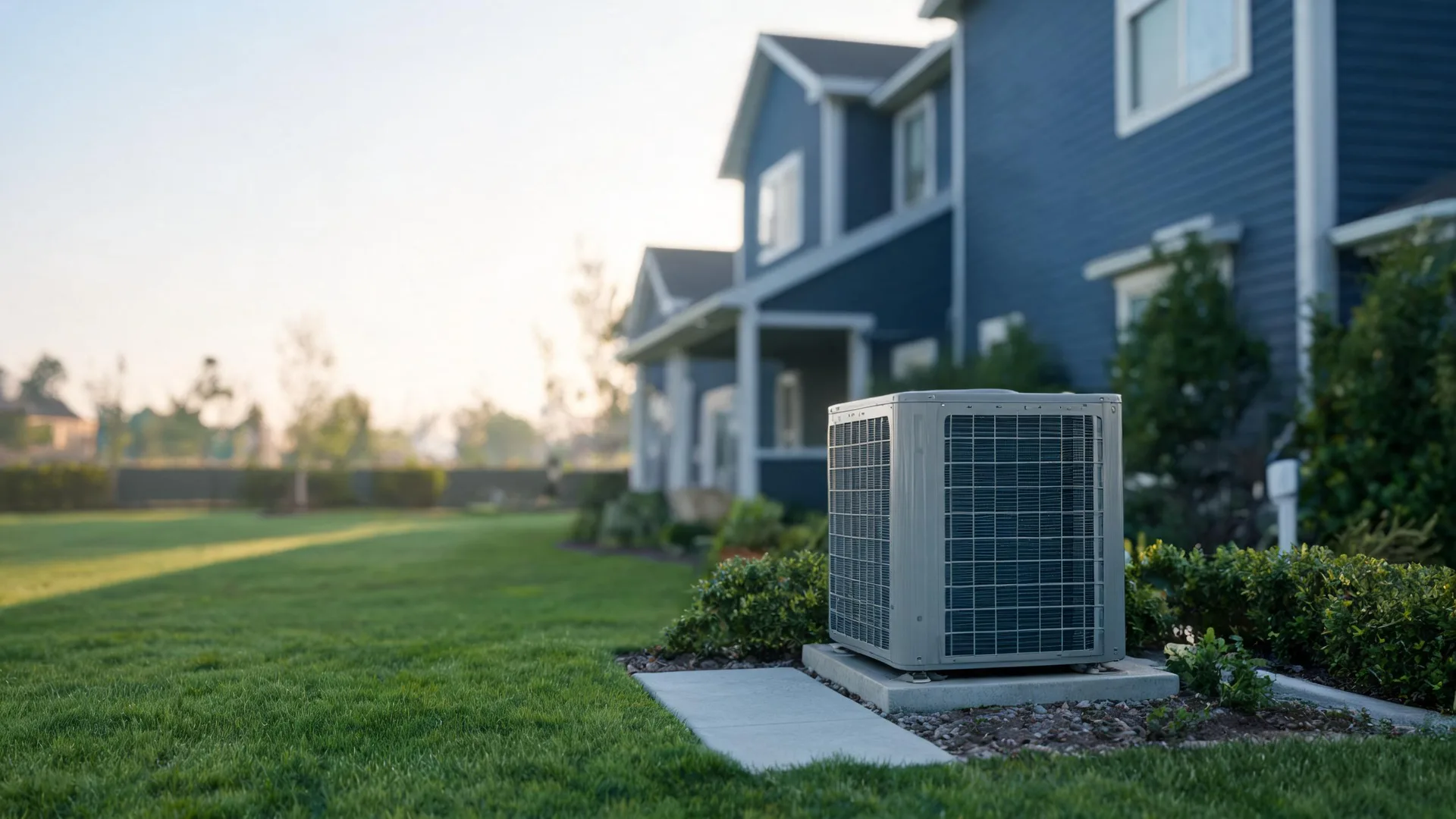
A gray heat pump condenser unit mounted on a concrete pad against the gray lap-siding exterior wall of a house.

What to check before you call

Before anyone comes out, there's a few things worth checking yourself. Go outside and look at the unit. If leaves, grass clippings or a dusting of ice are packed against the coil, clear it off by hand and see if that changes anything. Check that nothing is stacked against the sides or on top of it, since it needs open air on all sides to breathe. Inside, pull the air filter and hold it up to a light. If you can't see light through it, that's your problem or at least part of it. Look at every vent and register in the house and make sure none are closed or blocked by furniture or rugs. Check the thermostat is set to the mode you want and the batteries aren't low, since a thermostat that's losing power can make a heat pump act like it's broken when it isn't. If you've got a breaker panel, see if the breaker for the outdoor unit has tripped. None of this fixes a bad reversing valve or a worn compressor, but it rules out the easy stuff first.

Check it after the storm passes, not just when it stops working

Hail and wind damage doesn't always stop a heat pump from running that same day. A bent coil fin or a nicked fan blade can sit there for weeks before the strain catches up with the compressor. Looking it over after a bad storm catches the damage before it turns into a bigger repair.

A walk-around tells you less than a tech's look

Clearing leaves and debris off the coil is worth doing, and anyone can see a cracked housing from a few feet away. But checking the fan blade for balance or finding coil fins bent just enough to choke airflow takes pulling the unit apart. That's what a tech checks that a walk-around won't catch.

A heat pump that's working right doesn't make you guess. The signs are usually plain once you know what you're noticing. Air coming from the vents that isn't warm enough, even though the system is running and the thermostat is calling for heat. Ice building up on the outdoor unit that doesn't clear between cycles. The system short cycling, meaning it kicks on, runs a few minutes, and shuts off again before it's done anything useful. A hissing or bubbling sound near the lines outside usually means refrigerant is escaping where it shouldn't. The unit running far longer than it used to just to hold the house at the same temperature is another sign something in it is struggling. Any one of these on its own is worth a call. A few at once usually means whatever's causing it has been getting worse for a while.

A compressor that's wearing out doesn't usually quit all at once. It runs longer each cycle, struggles more to keep up, and a tech checking it finds the whole system short on capacity rather than one part broken outright. That's the case where a repair gets costly without getting you very far, because the part that failed is rarely the only one close to failing. A blown capacitor or a bad contactor is a different story. Those fail on their own, the rest of the unit is usually fine, and swapping the part solves it. The real question isn't just what broke, it's whether the system around that part has been struggling too. A tech can tell you which one you're dealing with. Guessing from how the air feels can't.