Why your heat pump has ice on it in a South Carolina winter

RepairHeat PumpSouth Carolina
Step 1 of 2

What ZIP code is the job in?

Why does my heat pump have ice on it in winter?

A little frost on the outdoor unit during a cold snap is normal, but a thick coat of ice that doesn't go away has you wondering if something's wrong. You've seen your heat pump run through plenty of winters here, and this doesn't look like the usual light frost that clears off on its own by afternoon.

A heat pump that stays iced up has a defrost cycle that isn't working

Your heat pump is built to frost over some. It pulls heat from outside air even when that air is cold, and moisture in the air collects as frost on the outdoor coil. A normal unit runs a defrost cycle every so often, the fan stops, the system reverses, and the ice melts off in a few minutes. If the coil stays iced instead of shedding it, the defrost control, a sensor, or the reversing valve isn't doing its job. In South Carolina winters, where temperatures swing above and below freezing on the same day, a heat pump leans on that cycle a lot. A unit stuck in a layer of ice loses heat output and runs harder to keep your house warm, and it won't clear on its own.

A smiling bearded man in a dark long-sleeved shirt sits on a brown leather sofa in a living room, with a large glass bowl of popcorn on a table in the foreground and a houseplant and doorway behind him.
A smiling man with gray-streaked hair and a beard in a dark blue sweater reclines on a sofa in a living room with a lit wood stove, shelves, wicker baskets and a bowl of popcorn on a table.
A smiling bearded man in a dark plaid shirt sits on a green couch beside a cushion and a wooden bowl of popcorn, with a blurred kitchen and living area behind him.
A smiling bearded man in a dark green henley shirt sits on a gray couch in a living room with a bookshelf, lit lamp, houseplant and framed picture behind him, and a bowl of popcorn in the foreground.

Frost That's Fine vs. Ice That Isn't

Normal frost

  • A thin, patchy layer of frost on the coil or the bottom of the unit during a cold snap is part of how a heat pump works.
  • The unit runs a defrost cycle on its own, reversing briefly to melt that frost and sending warm air out the top as steam.
  • You'll see this most on damp, near-freezing nights, the kind South Carolina gets plenty of in January.
  • The frost clears within an hour or so and doesn't build back up thick before the next cycle.
  • Airflow through the outdoor fan stays clear and the coil fins are still visible underneath.

Ice that needs a look

  • A solid sheet of ice covering the coil or fan means the defrost cycle isn't doing its job anymore.
  • Ice packed around the base or climbing up the sides points to a drainage problem or a fan that's stopped turning.
  • If the unit keeps running but the house isn't getting warm, the ice is blocking the airflow it needs to work.
  • A failed defrost control board or a low refrigerant charge are common reasons the cycle stops kicking in.
  • Ice that's still there the next morning, instead of melting off after an hour, isn't resolving itself.
A gray outdoor condenser unit on a concrete pad beside a house with gray lap siding, connected by conduit and refrigerant lines to a wall-mounted disconnect box, with a green shrub and mulch bed at left.

Running normally

This is what your unit looks like most of the winter. The fan turns, the coil stays clear, and any frost that forms burns off within the hour. No ice on the ground under it, no ice on the lines, no struggle to keep the fan blades turning.

An outdoor air conditioning or heat pump condenser unit on a concrete pad beside a house with horizontal vinyl siding, a gray electrical disconnect box and conduit on the wall, and a concrete walkway in the foreground.

Iced over

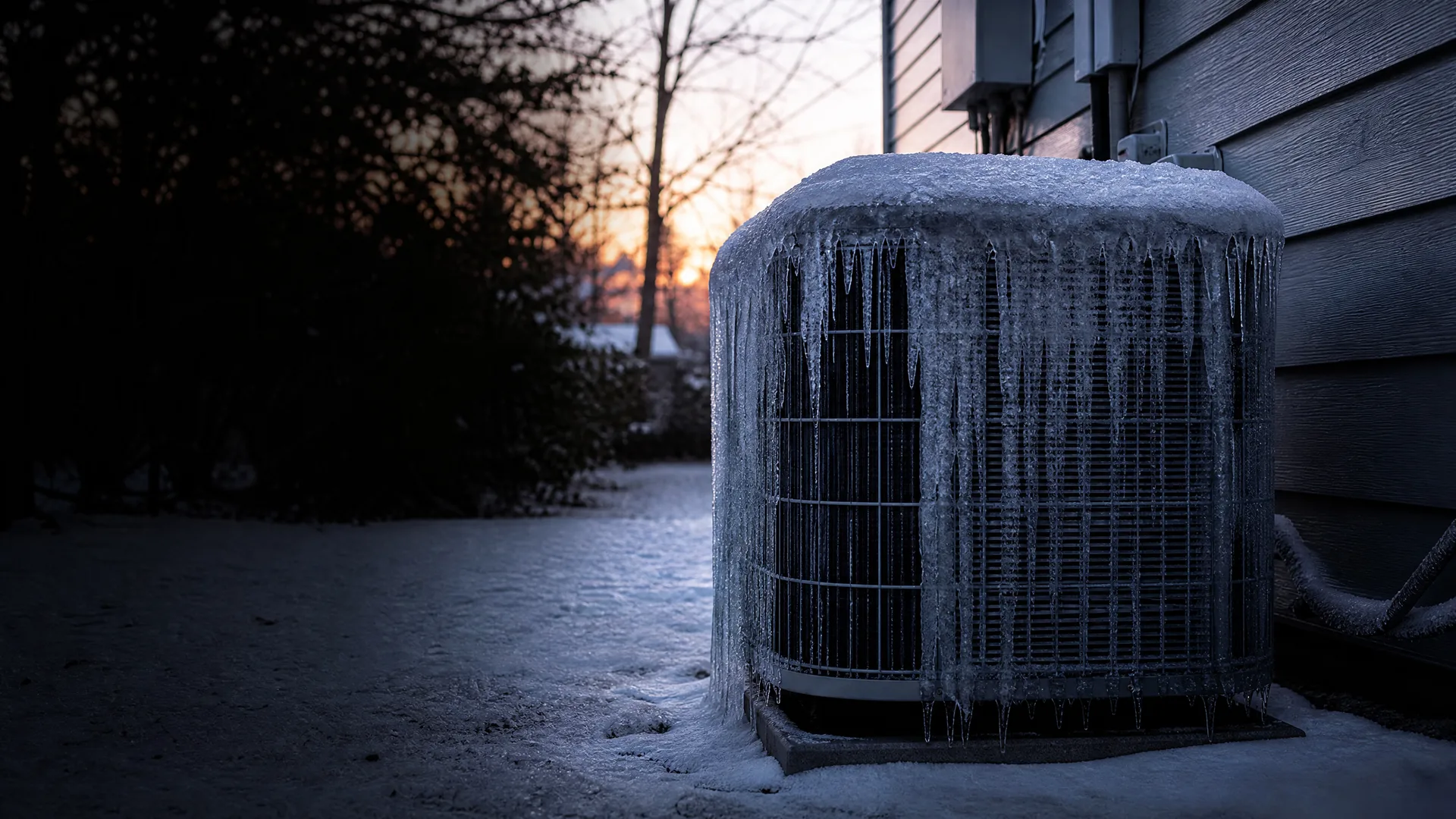
This is the unit calling for help. Ice has built up over the coil and down the side, the fan may be struggling to turn, and it hasn't cleared on its own in hours. Left alone, it stops moving heat and can strain the compressor.

A woman with dark hair in a bun sits on a beige sofa under a knit blanket with her eyes closed and an open book in front of her, with a lit lamp and houseplant in the background.
A smiling bearded man in a dark sweater sits at a dinner table with lit candles, a glass of red wine, and bowls of food, in a dimly lit room with a lamp and houseplant behind him.

How defrost actually works

  • A heat pump moves heat from the outdoor air even in cold weather, which pulls moisture out of that air onto the coil.
  • That moisture freezes on the coil, and the unit checks for ice with a sensor or a built-in timer, not by how cold it is outside.
  • When it decides defrost is needed, a reversing valve switches the system into cooling mode for a few minutes, sending hot gas to the outdoor coil.
  • The outdoor fan shuts off during defrost so the heat stays on the coil instead of blowing away, and steam rising off the unit is the ice melting.
  • Supplemental heat strips or a gas furnace kick on inside during defrost so the house isn't blowing cold air while the outdoor unit works on the ice.
  • If the reversing valve sticks, the defrost sensor fails, or the fan doesn't shut off when it should, the coil keeps icing over and the cycle never clears it.

Your heat pump spends the winter pulling heat out of outdoor air, even when that air is cold, and the process leaves moisture on the outdoor coil the same way a cold glass sweats on a humid day. That moisture turns to frost, then ice, and the system has to deal with it on its own schedule. It isn't watching a thermometer. A sensor or a timer tells it when enough ice has built up, and at that point the reversing valve flips the whole system into cooling mode for a few minutes. Hot refrigerant gas runs through the outdoor coil instead of the indoor one, and that heat is what melts the ice. The outdoor fan shuts off at the same time, because moving air across the coil during defrost would carry that heat away before it did its job. Inside, heat strips or a furnace pick up the slack so you're not getting a blast of cold air out of the vents while the outside unit handles the ice. Once the coil clears, the system switches back to heating and the fan starts again. The whole thing is supposed to take a few minutes and happen a handful of times during a cold stretch. When it works, you might never notice it happening. When the reversing valve sticks, the sensor stops reading correctly, or the fan keeps running when it should be off, the coil never fully clears, and the ice has nowhere to go but thicker.

An outdoor air conditioning condenser unit on a concrete pad beside a house with horizontal siding and a concrete foundation, with refrigerant lines running to a wall-mounted disconnect box and shrubs at left.
Before you get your heat pump repair
A gray outdoor air conditioner or heat pump unit on a concrete pad beside a house with horizontal lap siding, with conduit and refrigerant lines running up the wall and green shrubs and mulch at left.
After you get your heat pump repair
A single-story red brick ranch house with a white front door, white-trimmed windows and shingled roof, fronted by a wide asphalt driveway with sun flare, flanked by green trees and grass.

South Carolina summers average a dew point of 69°F across June, July and August, according to NOAA climate data. That kind of moisture load doesn't disappear in winter. The same coil that pulls water out of thick summer air pulls it out of cold winter air too, and that's the moisture that turns to ice when the outdoor temperature drops. If your defrost cycle isn't clearing it, the ice builds instead of melting off. Once you send in the form, you're done hunting for a contractor, calling around, and explaining the problem over and over. That part is off your plate.

NASA POWER T2MDEW county cells weighted by homes

Done looking for a heat pump pro

A heat pump caked in ice through a cold snap won't heat your house right, no matter how long you let it run. The coil can't pull heat from the outside air when it's covered, so the system works harder and still falls short, and in a bad case it can freeze the compressor itself. That's not something to wait out until spring. Right now, fixing it means finding a contractor who works on heat pumps, checking they're licensed, calling around for someone who can actually come out, and explaining the ice, the frost pattern, and what the unit's been doing all over again to each one. Send the request instead and that part stops being yours to manage. One licensed South Carolina contractor gets your information and takes it from there, so you're not juggling quotes or waiting on callbacks while your house sits at the wrong temperature with ice building up outside.

A gray outdoor condenser unit on a concrete pad beside a house with stacked stone and horizontal siding, surrounded by gray gravel and a plain light wall.

The reversing valve switches flow

A heat pump has a reversing valve that sends the refrigerant one way to heat your house and the other way to put the system into defrost. When the valve sticks or fails, the unit can't flip into that cycle at all. Frost builds with nothing to stop it, and the outdoor coil stays cold enough to keep pulling moisture out of the air and freezing it in place, hour after hour.

A dark gray outdoor heat pump unit sits on a concrete pad beside a white stucco wall and lap-sided house corner, with mulch and a small shrub in the foreground.

The defrost board controls timing

A timer or control board on the unit decides when to start and stop a defrost cycle, usually based on how long the system has run and the coil temperature it reads from a sensor. If that sensor gives a bad reading or the board fails, the unit can skip defrost entirely or end it too soon. Either way, ice keeps a foothold on the coil instead of melting off the way it should.

A closed laptop and a speckled ceramic mug sit on a wooden table beside a stoneware vase with a leafy branch, with a wooden chair, kitchen counter with cutting board and bowl, and dark upper cabinets in the dim background.

What a frozen heat pump means for your house

While the outdoor unit sits iced up, your living room vents are blowing air that isn't warm enough, and the thermostat can't figure out why the house won't reach the number you set. Electric heat is how most homes in South Carolina stay warm, so a heat pump that can't pull heat from the outside air just means more electric strip heat kicking in to cover the gap, running longer for less warmth. Leave it iced over through a hard freeze and you risk a cracked line or a seized compressor, which turns a repair into a replacement.

You don't have time most evenings to sort through who's licensed, who answers the phone, and who actually shows up during a cold snap when every heat pump in the neighborhood is doing the same thing. Sending one form means you're not the one calling around, describing the ice on your unit three different times to three different companies, or stacking up quotes to compare. That part stops being yours to carry.

Interior corner of a living room with a sheer-curtained window, a light wood console table holding a vase of greenery and a shallow bowl, a woven basket on the lower shelf, and a blurred upholstered sofa and dark wood table in the foreground.
A gray outdoor condenser unit on a concrete pad beside a light-colored lap-sided house, with a wall-mounted disconnect box and conduit, dark mulch, and a green shrub to the right.

The unit when it's working

The grilles are clean enough to see through, and the fan spins free. Frost shows up during a cold snap and is gone within the hour. The disconnect box and the lines running to it sit untouched, no ice creeping onto either one.

An outdoor air conditioner condenser unit on a concrete pad beside a house with horizontal lap siding, with a gray electrical disconnect box and conduit on the wall and bare dirt and mulch in the foreground.

The unit when it's not

Dust and grime have packed into the grilles until air can barely get through them. That buildup gives ice somewhere to grab and hold once the coil gets cold, and a defrost cycle that should clear it in an hour can't keep up.

Power costs 15.12 cents per kilowatt-hour statewide

At 15.12 cents a kilowatt-hour, a heat pump stuck in defrost or running flat out on backup heat shows up fast on your bill. A unit that can't clear its own ice leans on electric strip heat to keep the house warm, and that's the most expensive way to heat a room.

EIA-861 2025 statewide residential average

An outdoor condenser unit beside a horizontally sided house, encased in thick ice with hanging icicles, on snow-covered ground at dusk with bare trees and a sunset behind.

The sun isn't up yet when you pull back the curtain, and the side yard is still blue-gray with early light. Frost sits heavy on the grass, but your eye goes straight to the unit by the fence. It's not dusted with frost like you've seen before. The whole cabinet is sealed in ice, thick over the grilles, down the sides, a crust clinging to the copper lines running into the wall. No steam rising off the top this morning. No sound of the fan trying to turn. Just that ice, holding everything still, while the house behind you stays a few degrees short of where you set the thermostat.

A heat pump that stays iced up through a cold snap has a part that isn't doing its job, whether that's the defrost control, the reversing valve, or a sensor giving it bad information. Frost that melts on its own is normal. Ice that stays is not, and running the system through it only pushes more of your heat onto backup strip heat while the house still runs cold. You don't have to figure out which part it is before you ask for help, and you don't have to spend your evening calling around South Carolina for someone who works on heat pumps, explaining the same frozen coil to three different answering services, then stacking up quotes to see who's fair. Send the form once and that search is off your plate. Your heat pump still needs a licensed hand on it, but finding that hand stops being the thing standing between you and a warm house.

The dark metal gable roof and stone chimney of a house seen from above, with forested hills, cloud-covered mountains, and moss-draped tree branches framing the upper left.

It's off your list after this

Skip the calls

It costs nothing to send, and you don't have to hire anyone.

A frozen heat pump doesn't stop costing you money just because you stopped staring at it. Send the request and the search ends: no more calling around, no more explaining the ice on the phone twice over, no more sorting through quotes on your own time.